Multidomain Operations (MDO): A Complete Strategic and Educational Guide
Introduction
As international defense environments grow increasingly complex, military theorists and policy researchers study
Understanding the Core Concept
What is Multidomain Operations?
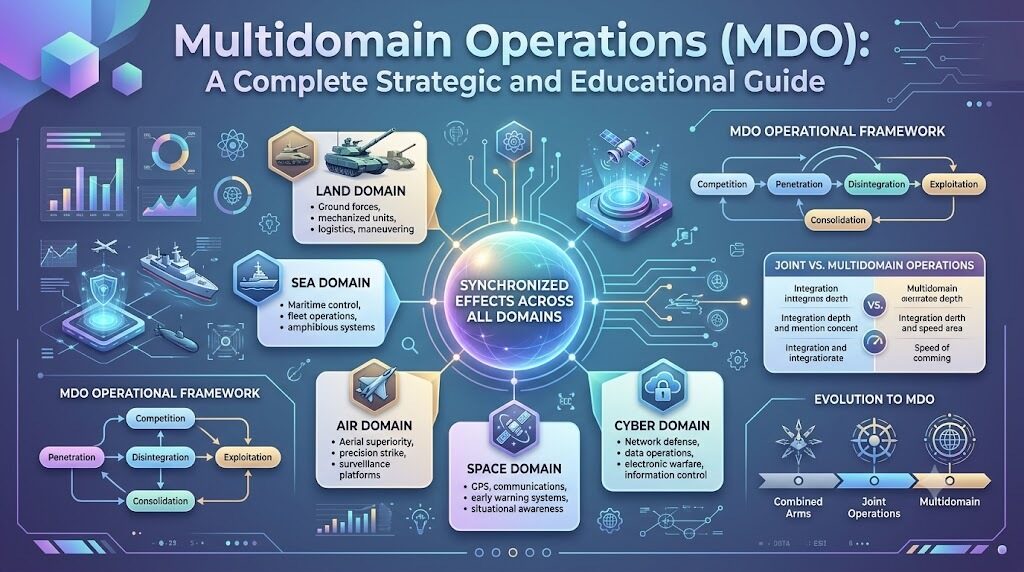
Multidomain Operations (MDO) refers to the strategic, operational, and organizational integration of capabilities across five primary operational domains: Land, Maritime, Air, Space, and Cyberspace, alongside the broader Information Environment.
Rather than deploying forces sequentially—where ground operations follow aerial bombardment or naval blockades—MDO emphasizes the simultaneous convergence of capabilities across all domains to present adversaries with multiple dilemmas.
Key Terminology
Operational Domain: A recognized sphere of activity or environment within which military operations are conducted (e.g., land, air, space).
Convergence: The deliberate, synchronized application of capabilities across domains to create specific strategic or operational effects.
Cross-Domain Synergy: The complementary use of capabilities in one domain to create advantages in another (e.g., using cyber assets to neutralize air defense systems).
Interoperability: The technical and organizational ability of different military units, branches, or allied nations to communicate and work together effectively.
Why MDO Matters in Defense Studies
For academic researchers and students of defense policy, MDO represents a shift in institutional thinking. It highlights that isolated domain superiority is rarely sufficient in modern defense planning. Studying MDO helps researchers understand how technological innovation, command architecture, and organizational adaptation interact within complex defense ecosystems.
Strategic Context and Objectives
Strategy vs. Operations vs. Tactics
Understanding MDO requires distinguishing between levels of military analysis:
Strategic Level: Focuses on national security goals, long-term policy objectives, broad resource allocation, and coalition building.
Operational Level: Links strategic objectives to tactical actions by designing campaigns, managing theaters, and coordinating cross-domain forces.
Tactical Level: Refers to the specific execution of individual engagements, unit movements, and local tasks.
MDO operates primarily at the strategic and operational levels, serving as a framework to align multi-service capabilities with overarching strategic objectives.
Strategic Objectives of MDO
The core objective of multidomain operational concepts is to prevent isolated vulnerabilities. If an organization relies exclusively on one domain—such as maritime superiority—an adversary focused on counter-space or cyber operations could disrupt that reliance. By distributing capabilities across multiple domains, defense planners aim to maintain operational flexibility, build resilience, and enhance strategic deterrence.
The Five Operational Domains and the Information Environment
To understand how MDO functions, researchers analyze the unique characteristics and interactions of each operational domain:
1. Land Domain
Ground forces provide physical presence, terrain control, and direct engagement with populations and localized infrastructure. In MDO, ground formations act not only as maneuvers units but as sensors and launchers capable of influencing air, cyber, and space domains.
2. Maritime Domain
Naval operations encompass surface fleets, subsurface assets, and amphibious capabilities. The maritime domain controls global trade routes, projects sea-based logistics, and provides mobile platforms for air defense, long-range fires, and undersea surveillance.
3. Air Domain
Aerial platforms offer rapid mobility, flexible payload deployment, high-altitude surveillance, and strategic strike options. Within multidomain concepts, air capabilities rely heavily on space-based navigation and resilient ground-based logistics.
4. Space Domain
Orbital assets provide satellite communications, early warning systems, environmental monitoring, positioning, navigation, and timing (PNT) data. The space domain acts as a global connective tissue for modern communication and ISR infrastructure.
5. Cyberspace Domain
Cyberspace involves hardware, software, network infrastructure, and data flows. Unlike physical domains, cyberspace is entirely human-created and constantly shifting. Cyber capabilities can defend command networks, secure communication nodes, or degrade adversary digital infrastructure.
The Information Environment
Transverse to all physical and digital domains, the Information Environment encompasses data transmission, cognitive perception, public communication, and strategic signaling. Managing information flows effectively ensures commanders retain situational awareness while preventing strategic miscalculation.
Command and Control Systems in MDO
Command and Control (C2) refers to the organizational structures, leadership processes, communication protocols, and information architecture used by military leaders to plan, direct, and monitor forces.
The Evolution of Command Architecture
Historical command systems relied on hierarchical, domain-isolated chains of command. Ground forces reported to ground commanders, while naval forces operated through separate admiralty structures.
MDO requires modern Joint Command Frameworks and Networked Decision Architecture. Under these systems, decision-makers draw data from sensors across all domains into a unified operational picture.
Key Elements of Modern C2 Architecture
Interoperable Data Networks: Ensuring software, radios, and databases across different services can exchange information seamlessly.
Decentralized Execution: Empowering lower-level commanders to make rapid decisions based on strategic intent when communications are degraded.
Data Aggregation: Filtering vast volumes of incoming intelligence into actionable insights to avoid information overload.
Defense Technology Enablers
Technological advancements drive the feasibility of multidomain operations. Defense studies analyze these systems as enablers of organizational capability rather than isolated tools.
Artificial Intelligence and Machine Learning: AI algorithms assist researchers and staff officers by processing massive sensor streams, predicting logistics shortages, and accelerating data evaluation.
Autonomous and Uncrewed Platforms: Unmanned aerial vehicles (UAVs), autonomous underwater vehicles (AUVs), and uncrewed ground systems expand sensor reach while reducing risk to personnel.
Cloud and Edge Computing: Secure military cloud architectures allow large data centers to process information globally while tactical edge devices deliver localized computing power to remote forces.
Advanced Communications and Sensors: High-bandwidth, resilient tactical data links connect terrestrial systems with orbital platforms, maintaining network stability across long distances.
Military Logistics and Sustainment in MDO
Logistics is the science of planning and executing the movement and maintenance of forces. In a multidomain context, sustainment faces unique systemic challenges.
Distributed Logistics
Traditional military logistics relied on large, centralized supply depots and predictable supply routes. In modern multidomain planning, defense analysts study distributed logistics—spreading supply nodes across broader geographic areas to enhance resilience and prevent single points of failure.
Predictive Sustainment
Modern sustainment leverages data sensors on equipment, vehicles, and platforms to monitor wear and usage in real time. Predictive algorithms allow logistics planners to dispatch replacement parts and maintenance crews before critical failures occur, reducing transportation overhead.
Supply Chain Security
Because multidomain forces depend on sophisticated microelectronics, specialized software, and secure fuels, defending supply chains against digital breaches, industrial disruptions, or component vulnerabilities is a priority for defense policy researchers.
Intelligence, Surveillance, and Reconnaissance (ISR)
ISR provides the foundational knowledge required for effective decision-making in multidomain environments.
Intelligence: The product resulting from the collection, processing, integration, evaluation, analysis, and interpretation of available information.
Surveillance: The systematic observation of aerospace, surface, subsurface, or digital areas by visual, electronic, or satellite means.
Reconnaissance: Focused, short-term missions undertaken to obtain specific information about environmental conditions or organizational postures.
In MDO, ISR systems pool data from radar, optical satellites, cyber monitoring, and human reports into an integrated framework. This fusion improves situational awareness, reduces uncertainty, and helps planners understand complex environments.
Comparative Analysis Table
The following table compares key operational elements within a modern defense framework:
| Defense Concept | Primary Focus | Key Components | Main Operational Challenge |
| Military Strategy | Aligning resources with long-term policy goals | Policy formulation, risk assessment, strategic resource allocation | Balancing long-term national priorities against limited budgets |
| Multidomain Operations | Cross-domain integration and simultaneous convergence | Land, Sea, Air, Space, Cyber, and Information synchronization | Harmonizing legacy systems across different military service branches |
| Command & Control (C2) | Decision-making architecture and coordination | Leadership hierarchy, communication networks, data management | Preventing information overload and maintaining network security |
| Military Logistics | Sustainment and readiness maintenance | Supply chains, maintenance, fuel distribution, transportation | Protecting long supply networks against physical and cyber disruption |
| ISR Systems | Situational awareness and information gathering | Orbital satellites, aerial sensors, cyber collection, analytics | Processing massive volumes of raw data into timely, useful insights |
Historical Development and Analytical Frameworks
Historical Evolution: From Combined Arms to Multidomain Operations
To appreciate modern MDO, defense students trace its historical antecedents:
Early 20th Century (Combined Arms): The initial integration of infantry, artillery, and early armored vehicles on land.
Mid-20th Century (Air-Sea-Land Integration): World War II demonstrated the necessity of amphibious operations and air-naval coordination in campaign planning.
Late 20th Century (Joint Warfare): The development of AirLand Battle concepts in the 1980s emphasized synchronizing air and ground capabilities across extended operational depths.
21st Century (Multidomain Operations): The inclusion of orbital satellites, global digital networks, and the information ecosystem expanded traditional joint concepts into true multi-domain integration.
Strategic Analysis Framework for Defense Students
Researchers can evaluate defense concepts using this 8-step structured framework:
Step 1: Define the Strategic Objective: Identify the primary policy or organizational goal.
Step 2: Identify Organizations and Actors: Map out the branches, agencies, or allied partners involved.
Step 3: Examine Resources and Constraints: Assess budget, industrial base, material limitations, and legal parameters.
Step 4: Analyze Information and Decision-Making Needs: Evaluate how information flows from sensors to leaders.
Step 5: Evaluate Logistics and Readiness: Determine how long supply chains and equipment maintenance can sustain operations.
Step 6: Assess Technology and Interoperability: Examine how software and hardware systems interface across domains.
Step 7: Consider Risks and Unintended Consequences: Identify points of failure, vulnerabilities, or escalation risks.
Step 8: Contextualize Historical and Policy Lessons: Compare current assessments against historical case studies.
Historical and Practical Learning Examples
Example 1: Historical Campaign Analysis (Air-Sea-Ground Coordination in WWII)
Context: The 1944 Normandy landings (Operation Overlord).
Analysis: Long before the term "multidomain" existed, strategic planners had to synchronize ground forces, naval gunfire, air support, airborne drops, and deception campaigns.
Takeaway for Students: The primary challenge was not the size of individual forces, but the operational timing and communications infrastructure required to make disparate components work together.
Example 2: Hypothetical Defense System Upgrade (Educational Case Study)
Context: A defense agency introduces a new space-based sensor network to improve early warning capabilities.
Analysis:
Leadership & Training: Officers must be trained to interpret data from unfamiliar orbital sensors.
Interoperability: Legacy ground computers must be updated to process satellite data formats.
Logistics: Ground control stations require backup power, secure maintenance access, and spare components.
Takeaway for Students: Adding technology to one domain requires structural adjustments across command, training, and sustainment systems.
Key Challenges, Limitations, and Misconceptions
Key Operational and Structural Challenges
Organizational Complexity: Coordinating strategies across military branches (Army, Navy, Air Force, Space Force, Cyber units) requires reconciling distinct institutional cultures and budgetary priorities.
Information Overload: Advanced sensors generate petabytes of data. Without effective filtering, decision-makers can experience cognitive paralysis.
Cybersecurity and Vulnerabilities: Highly integrated digital networks create larger attack surfaces. Securing command systems against unauthorized disruption is an continuous effort.
Interoperability Gaps: Older legacy platforms often lack the hardware or software standards required to communicate directly with modern edge devices.
Common Misconceptions
Misconception 1: Strategy is just high-level tactics.
Reality: Strategy sets long-term goals and allocates national resources; tactics govern immediate local actions.
Misconception 2: Technology automatically guarantees success.
Reality: Advanced hardware is ineffective without clear organizational processes, rigorous maintenance, and sound leadership.
Misconception 3: Multidomain simply means using multiple technologies.
Reality: MDO requires active integration, synchronization, and institutional alignment, not just owning tools in different domains.
Misconception 4: More information always leads to better decisions.
Reality: Raw data without clear analysis, context, and verification causes delay and confusion.
Ethics and Responsible Defense Discussion
Academic studies of defense concepts must account for international law, policy frameworks, and ethical responsibilities:
Civilian Considerations and International Humanitarian Law: Strategic planners are obligated under international law to adhere to principles of distinction, proportionality, and military necessity to minimize civilian harm during conflict.
Human Oversight in Automated Systems: As AI and decision-support algorithms are integrated into command networks, maintaining meaningful human judgment over operational decisions remains a central policy focus.
Responsible Information Use: Managing public communications, intelligence distribution, and data privacy requires strict policy oversight to prevent disinformation and protect civil liberties.
Key Takeaways
Integration over Isolation: Multidomain Operations focus on converging capabilities across land, sea, air, space, cyber, and information environments simultaneously.
Beyond Joint Warfare: MDO expands traditional joint concepts by integrating non-physical domains like cyberspace and orbital space into core strategic planning.
Data as Connective Tissue: Command and Control in MDO relies on interoperable, secure networks that aggregate sensor data for timely decision-making.
Logistics Vulnerability: Sustaining distributed forces across vast distances requires predictive maintenance, resilient supply chains, and secure communications.
Human Leadership Matters: Advanced technologies enhance operational reach, but clear leadership, ethical frameworks, and human oversight remain essential.
Systemic Perspective: Analyzing defense concepts requires evaluating strategy, technology, policy, history, and organizational culture together.
Frequently Asked Questions (FAQs)
1. What is Multidomain Operations (MDO)?
Multidomain Operations is an educational and strategic framework focused on integrating capabilities across land, sea, air, space, and cyberspace. Rather than operating in isolation, forces synchronize actions across these environments to address complex operational challenges.
2. How does strategy differ from tactics in defense studies?
Strategy defines long-term policy goals, national priorities, and resource allocation. Operations connect strategy to tactical execution, while tactics govern specific movements, unit engagements, and localized tasks during engagements.
3. What role does the space domain play in modern defense systems?
The space domain provides infrastructure for satellite communication, global positioning (PNT), weather monitoring, and early warning surveillance. It acts as a connective layer supporting terrestrial and air operations.
4. Why is cyberspace considered an operational domain?
Cyberspace hosts the digital networks, command systems, and data infrastructure essential for modern operations. Disruption of digital channels impacts physical systems, making cyber defense critical to overall security.
5. What is Command and Control (C2)?
Command and Control refers to the leadership structures, operational protocols, communication channels, and software applications that allow military authorities to organize forces, process intelligence, and direct activities.
6. Why is military logistics critical in multidomain planning?
Forces cannot operate without continuous sustainment. Logistics encompasses fuel delivery, equipment repair, medical support, transportation, and supply chain security across physical and digital networks.
7. How does Artificial Intelligence support defense management?
AI tools process large datasets from multiple sensors, automate routine administrative tracking, assist with predictive maintenance in logistics, and provide decision-support analytics for strategic planners.
8. What is the difference between intelligence, surveillance, and reconnaissance?
Surveillance is continuous observation of an area; reconnaissance consists of targeted, short-term missions to gather specific facts; intelligence is the analyzed, contextualized product derived from evaluating both sources.
9. Why is military history important for analyzing modern defense concepts?
Military history provides documented case studies of strategic decisions, technological adaptations, and organizational shifts. Analyzing past campaigns helps researchers evaluate modern defense theories against real-world patterns.
10. Where can students and researchers find educational resources on defense studies?
Academic institutions, policy research journals, official institutional publications, and educational repositories like
Conclusion
Multidomain Operations represents an essential area of study for understanding modern defense architecture, strategic planning, and technological integration. By examining how land, maritime, air, space, and cyber domains interact, researchers gain deeper insight into how organizations manage complexity, build resilience, and adapt to shifting global security environments. Effective analysis requires looking beyond individual technologies to study command frameworks, sustainment networks, and historical contexts. For students, academics, and policy researchers seeking to expand their knowledge of strategic studies, organizational structures, and defense systems, platforms like