Architecting Enterprise Data Operations: Best Practices for High-Reliability Data Pipelines
Introduction
Data platforms frequently suffer from an operational paradox: writing initial transformation logic is quick, but keeping pipelines running smoothly in production is an endless struggle. Minor upstream adjustments—a modified column name, a missing key, or a transient API failure—regularly cascade downstream, breaking business dashboards and eroding trust in data products.
Historically, organizations attempted to solve these failures through manual oversight, reactive patch scripts, and ad-hoc troubleshooting. A modern DataOps pipeline shifts this paradigm entirely. Instead of treating data processing as a collection of standalone tasks, it re-imagines data workflows as version-controlled, continuously integrated software products.
By decoupling data processing logic from platform orchestration, embedding real-time quality constraints, and automating deployments, data organizations build resilience directly into their infrastructure.
This guide examines how to re-engineer data workflows around automation, structural testing, observability, and robust software patterns. For professionals and platforms advancing their operational capabilities through educational sites like
Redefining the DataOps Pipeline Concept
A DataOps pipeline isn't just a schedule running an SQL query or a Python script; it is a code-defined environment that governs data movement, guarantees structural integrity, tracks state, and self-audits at every step.
+-----------------------------------------------------------------------------------+
|                        CONTINUOUS DATA PROCESSING PARADIGM                       |
+-------------------+--------------------+--------------------+---------------------+
|  1. ADMISSION     |  2. COMPUTATION    |  3. VERIFICATION   |  4. EXPOSURE        |
|  - Ingestion APIs |  - Declarative SQL |  - Runtime Asserts |  - Serving Layer    |
|  - Schema Locks   |  - Spark / Engines |  - Metric Drift    |  - Lineage Tracking |
+-------------------+--------------------+--------------------+---------------------+
|                      Unified Versioning & Automated Deployments                    |
+-----------------------------------------------------------------------------------+
Moving Beyond Traditional ETL Architecture
Legacy batch processing assumes stable schemas and consistent data inputs. When reality diverges from those assumptions, traditional pipelines fail silently, populating downstream analytics with corrupted metrics.
By contrast, a modern DataOps framework approaches data engineering through software discipline:
Declarative Environments: System components—from cluster sizes to access policies—are managed as checked-in configuration artifacts rather than manual cloud UI tweaks.
Isolated Execution Branches: Changes to transformation logic are evaluated inside ephemeral sandboxes populated with non-sensitive test samples prior to production rollout.
Inline Integrity Gateways: Instead of validating data after it lands in analytics tables, data quality rules act as strict gates, blocking bad data mid-flight.
Traceable State Changes: Every schema change and pipeline deployment links directly to a specific Git commit hash, enabling instant rollback capabilities.
Automation vs. Intelligent Orchestration
While simple automation focuses on triggering a task at a specific time, intelligent orchestration maps complex execution graphs. It handles execution order, balances system loads, isolates failures, and prevents invalid dependencies from executing when upstream inputs fail.
Structural Anatomy of a Resilient Data Operations Stack
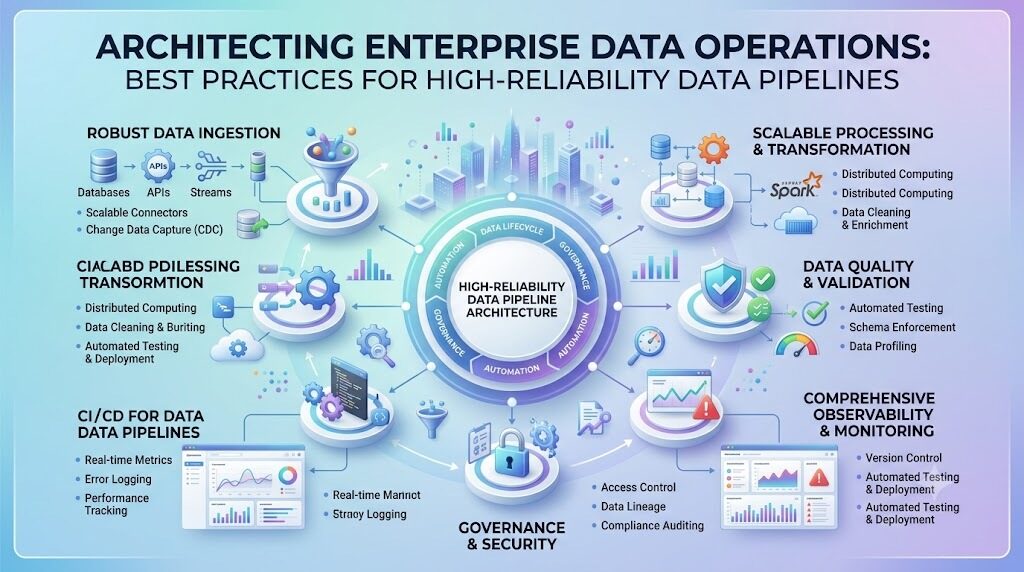
A robust data ecosystem segregates responsibilities into distinct operational layers, ensuring that changes in one component do not destabilize the rest of the infrastructure.
+----------------------------------------------------------------------------------+
|                          DECOUPLED DATA PLATFORM LAYERS                          |
+----------------------------------------------------------------------------------+
| 1. Data Capture Layer    | Event Streaming, CDC, API Connectors                  |
| 2. Orchestration Engine  | Execution Graphs, Stateful Scheduling, Dependency Logic|
| 3. Distributed Compute   | Transformation Logic, Vectorized Querying             |
| 4. Operational Gateways  | Schema Validation, Contract Enforcement, Assertions  |
| 5. Telemetry & Telemetry  | Telemetry Collectors, Lineage Graphs, Drift Monitors |
| 6. Deployment Pipeline   | CI/CD Drivers, Static Analysis, Environment Isolation |
+----------------------------------------------------------------------------------+
Data Capture Layer: Manages connections to external APIs, databases via Change Data Capture (CDC), and event streaming buses with strict schema enforcement at admission.
Orchestration Engine: Manages task dependencies, execution state, error retries, and runtime metadata across heterogeneous environments.
Distributed Compute Layer: Executes heavy mathematical transformations, aggregations, and data formatting using cloud-native compute engines.
Operational Quality Gateways: Runs runtime validation checks, asserting business logic constraints before records reach serving endpoints.
Telemetry & Lineage Layer: Captures platform metrics, runtime durations, execution costs, volume variance, and record trace paths.
Deployment Pipeline: Drives release management through automated code validation, environment provisioning, and automated testing suites.
Operational Alignment: DataOps vs. Parallel Engineering Disciplines
Understanding how DataOps interacts with and differs from adjacent disciplines helps clarify organizational responsibilities and skill requirements.
| Discipline | Core Focus | Key Daily Activities | Primary Success Metrics |
| DataOps | Operational health, data delivery reliability, pipeline automation. | Building CI/CD for pipelines, managing testing suites, tracking observability, setting up retry mechanisms. | System uptime, Mean Time to Detect (MTTD), data freshness SLAs, test coverage. |
| Data Engineering | Architecture, data modeling, query optimization. | Writing complex transformations, modeling schemas, tuning analytical database performance. | Processing throughput, query latency, storage optimization, pipeline efficiency. |
| DevOps | Application availability, cloud infrastructure, release mechanics. | Infrastructure provisioning, Kubernetes administration, managing software deployment channels. | Deployment frequency, change failure rate, system availability, cloud cost efficiency. |
| MLOps | Model operationalization, parameter drift, feature serving. | Automating retraining loops, managing feature stores, monitoring inference performance. | Model accuracy over time, prediction latency, training reproducibility, feature drift. |
| Platform Engineering | Developer tooling, platform self-service, internal portals. | Provisioning internal developer environments, maintaining shared deployment templates, enforcing guardrails. | Developer velocity, self-service adoption, platform standard adherence. |
CI/CD and Quality Assurance for Dynamic Data Systems
Deploying software code is fundamentally different from deploying data transformations. Software releases deal with stateless logic, whereas data engineering modifies stateful, ever-growing systems.
DEVELOPMENT               AUTOMATED VALIDATION                 PRODUCTION DEPLOY
+---------------+         +-----------------------+            +-------------------+
| Feature Branch|         | - Static Code Linter  |            | Merged to Master  |
| - Edit Logic  | ------> | - Dry-Run SQL Compiler| ---------> | - Deploy Artifacts|
| - Local Tests |         | - Run Integration Tests| (Passed)  | - Refresh Graphs  |
+---------------+         +-----------------------+            +-------------------+
Building the Continuous Integration Workflow
A mature release process for data pipelines incorporates automated validation stages before any modification enters the main codebase:
Branch Isolation: Engineers develop new feature code inside temporary Git branches isolated from production production schedules.
Automated Static Verification: Submitting a change triggers automated jobs that parse syntax, format SQL queries, and flag security anti-patterns.
Sandbox Compilation: The CI runner compiles the pipeline graph against a isolated sandbox database, verifying that table references and data types align.
Integration Testing: Representative data samples run through the compiled logic to verify that structural constraints hold true under load.
Zero-Downtime Deployment: Verified changes are merged into production. The orchestrator updates running tasks seamlessly without interrupting active reading jobs.
Multi-Tiered Data Validation Strategy
Quality control cannot be an afterthought run at the end of the week. It must be built directly into runtime execution across three distinct zones:
Admission Control (Edge Checks): Validate that incoming payloads match expected schemas, verifying field structures before data lands in raw storage.
Transformation Validation (In-Flight Checks): Evaluate calculated fields, join conditions, and business constraints (e.g., verifying
inventory_count >= 0) during execution.Serving Assertions (Outbound Checks): Verify overall dataset metrics—such as row count variance and historical statistical distributions—before pointing BI applications to refreshed tables.
Deep Visibility: Data Observability Frameworks
Traditional monitoring focuses on server health—alerting if a cloud node runs out of memory or an application crashes. Data observability looks inside the datasets themselves, identifying subtle data corruption that standard infrastructure monitoring misses.
+---------------------------------------------------------------------------------+
|                        THE 5 AXES OF SYSTEM OBSERVABILITY                       |
+-------------------+-------------------+--------------------+--------------------+
| 1. TIMELINESS     | 2. VOLUMETRICS    | 3. SCHEMA STABILITY| 4. STATISTICAL ADH.|
| Is data landing on| Are record counts | Have attributes    | Do field values    |
| expected schedule?| within norms?     | changed format?    | match parameters?  |
+-------------------+-------------------+--------------------+--------------------+
| 5. LINEAGE MAPS: How do changes propagate from raw ingestion to final outputs?  |
+---------------------------------------------------------------------------------+
The Five Pillars of Advanced Observability
Timeliness: Tracks the elapsed time between data generation and its arrival at analytics endpoints, highlighting processing lag.
Volumetrics: Measures incoming and outgoing record volumes to detect missing batches or unexpected data duplication.
Schema Stability: Detects structural drift, such as unexpected field deletions, altered column data types, or new unmapped keys.
Statistical Adherence: Analyzes numerical distributions, null ratios, and categorical frequencies to flag silent data corruption.
Lineage Mapping: Tracks dependencies across complex transformation graphs, showing exactly how an upstream outage affects downstream reports.
Strategic Selection of DataOps Tooling
Rather than relying on a single monolithic platform, modern data architecture relies on a modular, decoupled ecosystem where specialized components communicate via open interfaces.
+----------------------------------------------------------------------------------+
|                            FUNCTIONAL TOOLING LAYERS                             |
+-------------------+--------------------+--------------------+---------------------+
| CATEGORY          | PRIMARY FOCUS      | REPRESENTATIVE TECHNOLOGIES         |
+-------------------+--------------------+--------------------+---------------------+
| Orchestration     | Stateful DAGs &    | Apache Airflow, Dagster, Prefect    |
|                   | task scheduling    |                                     |
| Data Admission    | Connectors & event | Airbyte, Fivetran, Apache Kafka     |
|                   | stream processing  |                                     |
| Processing Engine | Distributed query  | dbt, Apache Spark, Trino            |
|                   | & transformations  |                                     |
| Quality Gates     | Runtime schema &   | Great Expectations, Soda, Deequ     |
|                   | logic validation   |                                     |
| Observability     | Lineage, anomaly   | Monte Carlo, OpenLineage, Databand  |
| Deployment & IaC  | CI/CD drivers &    | GitHub Actions, Terraform, Docker   |
|                   | infra-as-code      |                                     |
+-------------------+--------------------+--------------------+---------------------+
Evaluation Metrics for Engine Selection
When reviewing software for a DataOps infrastructure, apply these fundamental engineering criteria:
Code-First Control: Choose tools configured through human-readable code files (YAML, Python, SQL) rather than proprietary user interfaces.
Extensibility via APIs: Ensure every tool provides comprehensive REST or gRPC interfaces for programmatic control, telemetry extraction, and workflow triggering.
Infrastructure Elasticity: Select execution engines that scale compute dynamically based on workload demands, shrinking to zero when idle.
Auditability and Lineage Support: Confirm that tools export standard telemetry formats (like OpenLineage) to maintain clear operational audit trails.
Step-By-Step Implementation Roadmap
Modernizing enterprise data operations requires a structured approach. Rather than attempting a risky, full-system overhaul, teams should roll out improvements incrementally.
+-----------------------------------------------------------------------------------+
|                        10-PHASE SYSTEM MODERNIZATION PATH                         |
+-----------------------------------------------------------------------------------+
| Phase 1: Audit Current Workflows     --> Map failure modes, debt, and manual steps|
| Phase 2: Pinpoint Friction Points   --> Focus on frequent causes of pipeline lag |
| Phase 3: Codify Operational SLAs    --> Define exact latency & freshness limits  |
| Phase 4: Centralize Code in Git     --> Move all SQL, scripts, and configs to Git|
| Phase 5: Automate Syntax Checks     --> Enforce uniform style and syntax linting  |
| Phase 6: Embed Quality Validation   --> Add schema and null checks to core DAGs  |
| Phase 7: Transition Orchestration   --> Migrate legacy cron jobs into task graphs|
| Phase 8: Instrument Observability   --> Deploy automated volume & drift tracking |
| Phase 9: Secure Infrastructure Access-> Implement secrets management and RBAC    |
| Phase 10: Analyze Metrics & Refine  --> Measure recovery times and iterate logic  |
+-----------------------------------------------------------------------------------+
Phase 1: Audit Current Workflows
Document existing pipelines, mapping every manual step, external reliance, and historical failure mode recorded over recent operational cycles.
Phase 2: Pinpoint Friction Points
Identify which tasks consume excessive engineering time, focusing first on pipelines that frequently break due to schema changes or unannounced source modifications.
Phase 3: Codify Operational SLAs
Define clear data delivery parameters, establishing binding freshness thresholds, error tolerances, and recovery time expectations for key business datasets.
Phase 4: Centralize Code Repositories
Migrate all floating scripts, scheduled queries, database ddl files, and orchestration rules into structured, version-controlled repositories.
Phase 5: Automate Syntax & Style Checks
Establish continuous integration rules that automatically lint code formatting, check for syntax errors, and flag security issues during pull request reviews.
Phase 6: Embed Inline Quality Validation
Insert automated schema and value validation steps directly into processing scripts, blocking broken data from leaking into production schemas.
Phase 7: Transition to Stateful Orchestration
Replace fragile cron scripts with modular execution graphs that manage task dependencies, handle transient failures gracefully, and log execution details.
Phase 8: Instrument End-to-End Observability
Deploy telemetry collectors across all pipelines to automatically track data freshness, record volume variance, and upstream-to-downstream lineage graphs.
Phase 9: Secure Infrastructure and Credentials
Eliminate hardcoded API keys and database credentials, replacing them with centralized secrets management systems and strict role-based access controls.
Phase 10: Continuously Measure Operational Progress
Track engineering health metrics—such as Mean Time to Restore (MTTR), deployment frequency, and pipeline failure rates—to drive ongoing architecture refinements.
Practical Operational Scenarios
These real-world engineering scenarios illustrate how modern DataOps practices mitigate common production issues.
Scenario A: Automated Pipeline Validation via CI/CD
A data team manages hundreds of analytical models. In legacy setups, modifying an SQL file risks breaking downstream reporting tables if a column name is mistyped.
[Engineer Modifies SQL] --> [Open Pull Request]
                                  |
                                  v
                       [Automated CI Runner]
                                  |
               +------------------+------------------+
               |                                     |
               v                                     v
     [Linting & Syntax Check]              [Spin Up Test Schema]
               |                                     |
               +------------------+------------------+
                                  |
                                  v
                      [Execute Test Transformation]
                                  |
                                  v
                      [Evaluate Quality Asserts]
                                  |
               +------------------+------------------+
               | (Pass)                              | (Fail)
               v                                     v
     [Merge to Main Branch]                [Block Pull Request]
               |                                     |
               v                                     v
     [Auto-Deploy Production]              [Notify Developer]
Under a DataOps Execution Pattern:
An engineer modifies a transformation script in a feature branch and opens a pull request.
The CI pipeline intercepts the request, launching a temporary, isolated schema inside the target warehouse.
The runner builds the modified models using sample datasets, evaluating static syntax, column references, and execution efficiency.
Automated tests check output properties: verifying primary key uniqueness, foreign key integrity, and expected column types.
If tests pass, the PR is merged, and the orchestrator deploys the updated code safely to production. If tests fail, the PR is blocked, preventing broken logic from entering production.
Scenario B: Intercepting Schema Drift at Ingestion
An upstream SaaS application updates its database schema, renaming a critical string attribute without notifying the analytics team.
[Upstream App Alters Column Name] --> [Ingestion Pipeline Triggers]
                                              |
                                              v
                                 [Schema Verification Check]
                                              |
                        +---------------------+---------------------+
                        | (Mismatch Detected)                       |
                        v                                           v
            [Isolate Incoming Batch]                    [Pause Downstream Tasks]
                        |                                           |
                        +---------------------+---------------------+
                                              |
                                              v
                               [Route Alert to Engineering]
                                              |
                                              v
                              [Production BI Displays Last Safe]
Under a DataOps Execution Pattern:
The ingestion task reads incoming payloads and checks them against registered schema definitions before writing to raw storage.
The validator flags the missing attribute and halts processing before malformed records reach the warehouse.
The platform pauses downstream transformations dependent on that schema, avoiding cascading errors across downstream reports.
An automated incident ticket containing the execution context, lineage map, and schema delta is routed to the on-call engineer.
Downstream dashboards continue serving the last verified dataset, preventing broken reports while engineers update the transformation models.
Strategic Pitfalls and Implementation Hazards
Navigating the transition to a DataOps architecture requires avoiding several common organizational and architectural traps.
1. Misinterpreting DataOps as Purely Tool Acquisition
The Hazard: Purchasing advanced observability or orchestration software without updating operational workflows usually results in complex, underutilized platforms.
Strategic Remedy: Focus on team practices, testing standards, and process discipline first. Software should support well-defined operational habits, not replace them.
2. Excessive Alerting and Notification Fatigue
The Hazard: Setting uncalibrated alert thresholds for minor statistical deviations creates notification noise, causing engineers to miss critical production failures.
Strategic Remedy: Separate alerts into distinct severity tiers. Reserve high-priority alerts (which trigger immediate on-call pages) exclusively for breaking schema failures or pipeline halts. Route minor statistical warnings to daily review digests.
3. Neglecting Environment Parity
The Hazard: Developing logic against static, non-representative local mock data causes unexpected failures when code encounters real production data volumes and variations.
Strategic Remedy: Maintain sandbox environments that mirror production configurations closely, using realistic, non-sensitive data samples to catch edge cases early.
4. Attempting Monolithic Platform Rewrites
The Hazard: Trying to rebuild an entire legacy data ecosystem in a single project leads to scope creep, extended outages, and team burnout.
Strategic Remedy: Modernize the platform step-by-step. Focus first on high-value, highly fragile data flows, establishing patterns that can be extended across the rest of the architecture over time.
Evaluation Matrix for DataOps Initiatives
Use this structured decision framework when evaluating new tools, platform architectures, or educational investments:
[1. Identify Problem] --> [2. Map Stakeholders] --> [3. Audit Tech Stack]
                                                           |
                                                           v
[6. Verify Governance] <-- [5. Assess Automation] <-- [4. Set SLAs]
         |
         v
[7. Compute TCO] ------> [8. Run Isolated PoC] ---> [9. Benchmark Metrics]
Identify the Core Operational Problem: Clearly define the main operational challenge—whether it is reducing processing lag, lowering change failure rates, or eliminating manual data cleanup.
Map Key Stakeholders: Identify every team interacting with the platform, including data engineers, analytics professionals, cloud administrators, and business consumers.
Audit Current Technical Stack: Document existing database engines, storage layers, execution environments, and security boundaries.
Define Service Level Agreements (SLAs): Establish required delivery times, processing latency limits, and acceptable error margins for critical data assets.
Assess Automation Capabilities: Verify that prospective platforms support programmatic control via robust APIs, CLIs, and code-based configuration files.
Verify Security and Compliance Support: Confirm compliance with security requirements, including secret management, encryption standards, role-based access controls (RBAC), and audit logging.
Compute Total Cost of Ownership (TCO): Calculate direct licensing fees, underlying cloud resource demands, setup labor, and long-term maintenance overhead.
Run an Isolated Proof of Concept (PoC): Test candidate technologies on an isolated production-like workflow before committing to full-scale adoption.
Benchmark Performance Metrics: Track post-implementation metrics against baseline numbers to verify improvements in delivery speed, pipeline reliability, and system uptime.
Security Safeguards, Governance, and Compliance
Automation must be paired with strict security controls to safeguard sensitive information as data flows through production environments.
Centralized Secrets Vaults: Pipeline code must access credentials through secure secret stores rather than hardcoded strings, injecting tokens dynamically at runtime.
Scoped Least-Privilege Execution: Background compute tasks and deployment runners should run using minimally scoped service accounts limited strictly to necessary storage paths.
Data Masking and Synthetic Test Data: Production data should be scrubbed, masked, or synthesized before being used in non-production development sandboxes to prevent exposing sensitive personal information (PII).
Automated Audit Logging: Capture detailed metadata for all schema alterations, access requests, and code deployments to maintain clear compliance records for regulatory standards.
Emerging Frontiers in Data Operations
Data platform architectures continue to evolve, driven by emerging software engineering patterns and cloud-native innovations.
Data Contracts: Increasing adoption of formal, machine-readable contracts between data producers and data consumers, ensuring schema updates are negotiated before deployment.
AI-Assisted Telemetry Analysis: Utilizing machine learning models to analyze historic execution telemetry, automatically tuning anomaly thresholds and assisting with root-cause analysis.
Ephemeral Serverless Compute Processing: Shifting away from persistent database clusters toward serverless compute engines that launch dynamically for specific processing tasks and shut down immediately after completion.
GitOps-Driven Infrastructure Management: Managing cloud storage, permissions, data engine parameters, and pipeline logic entirely through version-controlled code repositories.
Supporting Educational Resources at TheDataOps.org
Building high-performing, resilient data systems requires continuous skill development and strategic planning. As a specialized knowledge and educational platform,
Core Operational Modules: In-depth instructional guides explaining DataOps fundamentals, CI/CD pipeline automation, code-first orchestration, and platform architecture.
Practical Engineering Concepts: Practical educational content focused on real-world implementations, testing methodologies, and observability frameworks.
Career and Technical Upskilling: Structured learning paths designed to prepare engineers and platform architects for modern roles in data platform engineering and enterprise data management.
Enterprise Modernization Strategies: Comprehensive frameworks, evaluation rubrics, and architectural blueprints designed to help organizations transition from legacy processing to automated data platforms.
Practical Takeaways
DataOps is an Operational Methodology: It brings software engineering discipline—such as version control, automated testing, and CI/CD—to data engineering workflows.
Manage Everything as Code: Define pipeline logic, database transformations, execution schedules, and cloud infrastructure as checked-in code artifacts in Git.
Validate Data Throughout the Pipeline: Implement quality checks at admission, during transformation, and before serving data to prevent malformed records from reaching production endpoints.
Instrument Comprehensive Observability: Track the five core pillars of observability—timeliness, volumetrics, schema stability, statistical adherence, and lineage—to catch silent data issues early.
Isolate Execution Environments: Use temporary sandbox schemas during integration testing to validate code modifications safely before deploying to production.
Modernize Incrementally: Migrate legacy systems step-by-step, targeting high-value, high-friction data flows first to build momentum and establish stable operational patterns.
Frequently Asked Questions (FAQs)
1. What is a DataOps pipeline?
A DataOps pipeline is an automated, code-driven data workflow that ingests, transforms, validates, and delivers data. It applies Agile software methodologies, DevOps automation, continuous integration, and real-time quality checks to ensure data delivery remains reliable as systems scale.
2. How does DataOps differ from traditional Data Engineering?
Data engineering focuses primarily on writing queries, modeling data, and managing storage architectures. DataOps introduces operational discipline around those tasks—automating deployments via CI/CD pipelines, enforcing code validation, monitoring runtime health, and establishing self-healing operational workflows.
3. Why is CI/CD critical in modern data workflows?
CI/CD automates code testing, syntax validation, and deployment pipelines. It allows engineers to test modified SQL scripts and processing logic in isolated sandboxes before merging changes into production, preventing broken code from crashing production schedules.
4. What tools make up a typical DataOps platform?
A modern DataOps platform combines modular software across several layers: orchestration engines (e.g., Apache Airflow, Dagster), ingestion frameworks (e.g., Airbyte, Fivetran), processing tools (e.g., dbt, Apache Spark), automated quality suites (e.g., Great Expectations), observability tools, and CI/CD drivers.
5. How does data observability differ from infrastructure monitoring?
Infrastructure monitoring tracks system resources, such as CPU utilization, memory, and task exit codes. Data observability tracks the health of the data inside those systems—monitoring schema changes, data freshness, row count variations, and field value distributions to detect subtle data corruption.
6. How does inline data testing improve platform reliability?
Inline data testing evaluates data quality assertions mid-flight during execution. By asserting rules like primary key uniqueness or value range limits during transformations, bad records are blocked before they pollute production schemas and downstream business dashboards.
7. What core technical skills does a DataOps Engineer need?
A DataOps engineer needs a strong blend of software engineering and platform skills: advanced programming in Python or SQL, version control with Git, workflow orchestration, container management (Docker, Kubernetes), CI/CD pipeline automation, and data observability design.
8. What core topics should a DataOps learning path include?
A complete DataOps curriculum should cover foundational software principles, Git workflows, infrastructure as code, workflow orchestration, automated testing design, data quality frameworks, observability architecture, cloud security, and real-world system migration strategies.
9. What key metrics evaluate DataOps maturity?
Key performance indicators include deployment frequency, change failure rates, Lead Time for Changes, Mean Time to Detect (MTTD) data issues, Mean Time to Restore (MTTR) broken pipelines, overall test coverage ratios, and compliance with data freshness SLAs.
10. How does a DataOps architecture support security and compliance?
A DataOps architecture enforces governance by managing credentials through secure secret vaults, restricting compute access via least-privilege service accounts, masking sensitive fields in development environments, and maintaining complete lineage logs for auditability.
Conclusion
Building reliable data platforms requires moving beyond reactive troubleshooting and fragile manual processing. Embracing modern DataOps practices enables teams to transform brittle data pipelines into scalable, automated software products that deliver trustworthy analytics consistently.
By decoupling execution layers, automating continuous integration, embedding real-time quality controls, and instrumenting deep observability, engineering teams can focus on driving business value rather than fixing broken schedules.
As enterprise data ecosystems scale in volume and complexity, adopting modern operational disciplines is essential for long-term stability. Platforms like