AIOps in Production: Replacing Threshold Rules with Probabilistic Machine Intelligence
Introduction
As cloud architecture transitions to ephemeral, distributed microservice meshes, the raw volume of generated operational signals routinely breaches human analytical capacity. When complex systems degrade, conventional monitoring solutions trigger cascades of secondary alerts, obscuring the primary fault point and stalling emergency triage.
Artificial Intelligence for IT Operations (AIOps) shifts operational strategy from static threshold checking to continuous probabilistic inference. By executing real-time machine learning models over aggregated telemetry pipelines, AIOps isolates anomalies, exposes dependency paths, and accelerates incident resolution.
This engineering guide examines the mechanics of AIOps—spanning telemetry standardisation, dynamic baseline computation, graph-based causal reasoning, and safety-centric automation design. To explore specialized educational tracks, consulting frameworks, and technical resources, visit
Deconstructing AIOps: From Static Gatekeeping to Algorithmic Intelligence
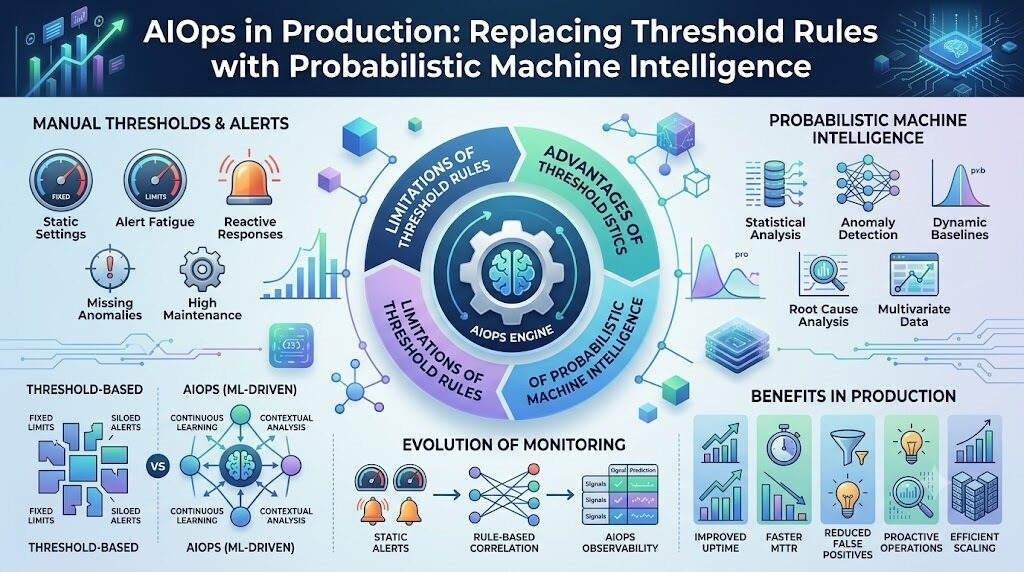
Legacy infrastructure monitoring relies on static conditions—such as raising an alarm whenever memory consumption breaches a hard 85% limit. In dynamic cloud environments, these rigid conditions generate constant false positives during routine workload bursts while missing subtle, compound performance degradations.
AIOps introduces adaptive behavioral modeling. By continuously computing moving probability distributions that account for seasonality, recurring cron jobs, and regional traffic variances, the system dynamically defines healthy performance baselines for every service node.
Operational Paradigm Shifts: Legacy Monitoring vs. AIOps
Legacy Monitoring: Operates on isolated component heuristics. It acts reactively, answering: Has a specific metric crossed its assigned threshold?
AIOps Engine: Evaluates end-to-end system health using probabilistic models and dependency graphs. It acts diagnostically, answering: Is system behavior deviating from expected baselines, what dependency pathways are involved, and where did the fault originate?
By processing raw telemetry into contextual intelligence, AIOps enables platform teams to transition from fire-fighting toward predictive reliability engineering.
Engineering Capabilities of Artificial Intelligence for IT Operations
Deploying machine intelligence across modern operational workflows requires distinct algorithmic disciplines across the incident lifecycle:
Adaptive Behavioral Baselining: Time-series ML algorithms continuously recalibrate operational parameters based on cyclical business hours, usage surges, and scheduled maintenance windows without manual rule edits.
Cross-Domain Event Suppression: During catastrophic multi-system outages, log-parsing engines and temporal clustering algorithms collapse thousands of redundant telemetry alerts into a consolidated incident record.
Topology-Driven Causal Isolation: By combining distributed tracing paths with live service-dependency graphs, AIOps platforms trace error propagation vectors back to the originating component.
Predictive Analytics: Forecasting models analyze memory allocation, thread pool consumption, and disk growth vectors to flag failure conditions before services suffer degradation.
Context-Enriched Remediation: The platform automatically enriches incident payloads with trace profiles, deployment diffs, and historical playbooks, executing automated remediation scripts for verified, low-risk routines.
Telemetry Pipeline: The Data Inputs of AIOps
Algorithmic inference depends entirely on the fidelity and coverage of the underlying observability stream. Complete visibility requires ingesting four distinct data types:
Metrics: High-frequency numeric measurements capturing time-series resource usage, throughput, and error rates. Metrics form the foundation for statistical anomaly detection.
Logs: Unstructured and semi-structured text records emitted by running services. Machine learning algorithms tokenize and cluster log text streams to detect novel error strings or anomalous message volumes.
Distributed Traces: End-to-end request path context across microservices. Tracing data maps service dependency graphs and identifies latency contribution bottlenecks.
System State & Change Telemetry: Real-time event feeds tracking CI/CD deployments, cloud resource provisioning, and feature-flag updates. Correlating operational state shifts with system anomalies accelerates root-cause identification.
Comparative Analysis: AIOps in the Modern Engineering Ecosystem
Understanding how AIOps interfaces with adjacent disciplines clarifies its role within modern software organizations.
| Engineering Domain | Core Focus | Traditional Mechanism | AIOps Synergy |
| Legacy IT Operations | Infrastructure uptime and host health. | Fixed-limit threshold checks and manual incident escalation. | Aggregates fragmented monitoring tool feeds and suppresses non-critical alert noise. |
| DevOps | High-velocity continuous delivery pipelines. | Infrastructure as Code (IaC) and deployment automation. | Correlates software deployment events directly with runtime system behavior. |
| Site Reliability Engineering (SRE) | System scalability, fault tolerance, and error budgets. | Service Level Indicators (SLIs) and Service Level Objectives (SLOs). | Automates repetitive operational tasks (toil), protects error budgets, and accelerates post-incident triage. |
| Observability | Inferring internal system states from external outputs. | High-fidelity collection of metrics, logs, and distributed traces. | Supplies the structured, high-resolution telemetry data required by machine learning models. |
| IT Service Management (ITSM) | Governance, service delivery, and ticketing processes. | Structured ITIL workflows and CMDB maintenance. | Enriches service tickets with automated diagnostic context and maintains live topology records. |
Field Scenarios in Enterprise Operations
Scenario 1: Taming Cascading Alert Storms in Cloud Storage
A primary cloud block store volume experiences storage controller degradation, causing I/O blocking across dozens of microservices.
Traditional Response: System monitoring triggers 900+ downstream alerts, ranging from database connection timeouts to HTTP 504 Gateway errors. On-call engineers spend critical time searching through duplicate notifications to find the root cause.
AIOps Workflow: The analytics engine processes the incoming telemetry stream, cross-references active service dependency graphs, and groups all 900+ notifications into a single incident: "Storage Controller Latency Spike on Block Volume A." The alert pinpointing the affected storage pool is dispatched directly to the infrastructure team, drastically cutting Mean Time to Detect (MTTD).
Scenario 2: Catching Latent Thread Exhaustion Before Service Outage
A software update introduces a thread leak in a payment gateway service, consuming worker threads at a slow, continuous rate over three days.
Traditional Response: Static alerts set at 90% thread pool capacity remain silent during low-traffic periods, triggering suddenly during peak hours and causing an unexpected outage.
AIOps Workflow: Machine learning models detect that thread pool consumption deviates from historical baselines within six hours of deployment. The platform flags an anomaly ticket to the software team, allowing the issue to be patched safely before customer impact occurs.
Architectural Blueprint for Enterprise AIOps
A resilient AIOps architecture relies on a multi-stage telemetry pipeline built for real-time, low-latency analysis.
Telemetry Collection Layer: Agents and sidecars gather raw metrics, log streams, tracing data, and configuration events across cloud, hybrid, and containerized runtimes.
Data Pipeline & Preprocessing Layer: Cleans incoming streams, standardizes formats (e.g., converting unstructured logs to JSON), aligns timestamps, and enforces schema consistency.
Analytics & Machine Learning Core: Applies time-series anomaly detection algorithms, runs log pattern clustering, and computes causal hypotheses using active topology models.
Decision Support & Orchestration Layer: Packages analytical output into actionable incident briefs enriched with deployment histories, system diffs, and runbook suggestions.
Operational Consumption Layer: Routes incident payloads to engineer messaging channels, ticketing platforms, or automated remediation workers.
Strategic AIOps Implementation Framework
Successfully deploying AIOps across an organization requires a structured, phased approach focused on data hygiene, culture, and iterative process refinement.
Step 1: System Audit and Objective Definition
Audit your current operational stack to isolate major friction points—such as high MTTR, alert fatigue, or fragmented monitoring tools. Establish clear operational baseline metrics to track implementation success.
Step 2: Telemetry Standardization and Schema Enforcement
Ensure all monitored components emit clean, structured data. Adopt open telemetry standards like OpenTelemetry, enforce structured logging protocols, and synchronize system clocks across all environments.
Step 3: Noise Reduction and Event Correlation
Deploy event aggregation models alongside existing monitoring tools. Focus initially on grouping duplicate alerts and using system topology mappings to eliminate notification noise.
Step 4: Fine-Tuning Anomaly Detection Models
Train behavioral baseline algorithms using historical telemetry datasets. Regularly review model outputs alongside operations teams to reduce false positives and fine-tune sensitivity thresholds.
Step 5: Controlled Automation with Guardrails
Connect incident analysis outputs to team communication channels and ITSM ticketing systems. Introduce automated remediation for routine, low-risk operational tasks—such as clearing log caches or scaling worker pools—supported by strict safety guardrails and human approval checkpoints.
Profile of the Modern AIOps Engineer
As organizations shift toward data-driven operations, the AIOps Engineer role has become critical for bridging infrastructure operations, data engineering, and reliability practices.
Core Skill Matrix for AIOps Engineers
Cloud Architecture & Containers: Advanced knowledge of Linux systems, container orchestration (Kubernetes), networking protocols, and public cloud architectures.
Observability Pipeline Engineering: Practical mastery of OpenTelemetry standards, Prometheus metric pipelines, log parsing pipelines (Elasticsearch/Fluentd), and distributed tracing tools.
Software Development & Automation: Strong programming skills in Python, Go, or shell scripting to construct custom integration pipelines, parse data schemas, and write automation handlers.
Applied Machine Learning Literacy: Practical understanding of time-series analysis, statistical modeling, clustering algorithms, and machine learning model validation techniques.
Site Reliability Engineering (SRE): Expertise in incident management frameworks, root-cause analysis methodologies, Service Level Objectives (SLOs), and post-incident review practices.
Engineers and teams seeking structured skills training and professional development resources can explore curriculum pathways and technical guides at
Platform Evaluation & Strategic Procurement
Selecting AIOps platforms, software tools, or external advisory services requires evaluating core technical criteria against long-term operational needs.
Technical Evaluation Criteria for Platforms
When assessing enterprise AIOps vendor solutions, technical teams should prioritize the following capabilities:
Integration Ecosystem Flexibility: Support for native, agentless telemetry ingestion from major cloud services, container platforms, and open-source monitoring frameworks.
Model Explainability & Transparency: Diagnostic outputs must clearly explain how a correlation was drawn or why a specific node was flagged as a likely root cause, avoiding opaque "black-box" conclusions.
Ingestion Scalability & Low Latency: The capacity to stream, parse, and analyze massive volumes of events per second during major system outages without introducing lag.
Data Governance & Security Controls: Robust role-based access management (RBAC), data masking for sensitive customer information (PII), end-to-end payload encryption, and complete audit logging.
Advisory & Consulting Considerations
Organizations transitioning legacy infrastructure often partner with specialized AIOps consulting teams to accelerate adoption. Key consulting focus areas include:
Assessing current operational maturity and telemetry pipeline health.
Building custom integration layers between legacy monitoring tools and modern correlation engines.
Establishing governance policies and guardrails for automated remediation workflows.
Implementation Pitfalls and Mitigation Strategies
Without proper planning, AIOps adoption initiatives can encounter operational roadblocks. Understanding these failure modes helps ensure a smooth rollout.
Pitfall 1: Unstructured Data & Low-Quality Inputs
The Problem: Inconsistent log formats, missing metric dimensions, and out-of-sync system clocks degrade model accuracy, causing frequent false alarms or missed anomalies.
Mitigation Strategy: Establish strict telemetry standards across development and operations teams before enabling machine learning analytics.
Pitfall 2: Uncontrolled Automation Execution
The Problem: Allowing automated remediation scripts to run on critical systems without proper validation controls can exacerbate minor system issues.
Mitigation Strategy: Implement safety guardrails. Require explicit human-in-the-loop approvals for actions on critical infrastructure, enforce execution rate limits, and verify rollback capabilities.
Pitfall 3: Overlaying AI on Flawed Operational Workflows
The Problem: Expecting an AIOps solution to automatically resolve issues stemming from poor team communication, unclear ownership, or unmaintained documentation.
Mitigation Strategy: Optimize your incident response workflows, service maps, and escalation paths before layering algorithmic analytics on top of your operations.
Responsible AI Governance and Operational Safety
Deploying machine learning models within enterprise infrastructure requires clear safety protocols, compliance standards, and human control points.
Human-in-the-Loop (HITL) Validation: Algorithmic suggestions—such as flagged root causes or proposed remediation runbooks—should provide clear confidence scores along with supporting data. Engineers retain ultimate authority to approve or halt automated actions.
Comprehensive Operational Auditability: Every recommendation, alert suppression, and executed automation script must be logged in an immutable audit trail for security reviews and post-incident analysis.
Telemetry Data Privacy & Masking: Telemetry pipelines must run inline data sanitization to strip private user data, API keys, and credentials before streaming data to analytics systems.
Emerging Horizons in Intelligent Operations
The intersection of artificial intelligence and operations engineering continues to advance rapidly, driven by several key developments:
Generative AI for Interactive Diagnostics: Large Language Models (LLMs) allow engineers to query system status using natural language, enabling intuitive interaction with complex telemetry stacks (e.g., "Summarize all error logs for service X following the last deploy").
Automated Incident Timelines: Systems that compile post-incident summaries automatically, pulling data from git commits, deployment logs, and team chat channels to generate draft post-mortems.
Platform Engineering Convergence: Integration of real-time AIOps telemetry directly into developer portals, providing immediate feedback on application health, cost efficiency, and reliability during deployment pipelines.
Practical Decision-Making Framework
Use this structured decision framework when evaluating an AIOps tool, platform adoption strategy, or learning path:
Identify Primary Operational Objectives: Focus on clear target goals, such as reducing alert volume, improving MTTD/MTTR, or automating routine infrastructure tasks.
Audit Telemetry Sources: Confirm that core metrics, logs, and trace pipelines are standardized and accessible across environments.
Define Ecosystem Integration Points: List all mandatory tool integrations across cloud platforms, orchestration engines, and communication channels.
Validate Algorithmic Transparency: Test whether vendor platforms provide clear, verifiable data trails behind their correlation and root-cause suggestions.
Establish Safety Guardrails: Specify which low-risk operational routines may be automated, keeping human-in-the-loop approval gates for critical production paths.
Execute a Focused Pilot Rollout: Deploy the platform on an isolated microservice environment, evaluate performance against your baseline operational metrics, and refine workflows before expanding deployment enterprise-wide.
5–8 Key Takeaways
AIOps Amplifies Human Expertise: Algorithmic models handle raw data crunching and noise filtering, allowing engineers to focus on high-level diagnostic decisions.
High-Fidelity Telemetry Is Mandatory: Machine learning insights depend directly on clean, standardized metrics, structured logs, and distributed traces.
Correlation Eliminates Alert Fatigue: Grouping thousands of secondary alerts into topology-aware incident briefs dramatically speeds up incident response.
Prioritize Safety-First Automation: Start by automating routine, low-risk operational tasks using clear safety guardrails and manual human approval gates.
Process Engineering Matters: Machine intelligence yields the best results when paired with mature SRE principles, clear service ownership, and structured incident management workflows.
Frequently Asked Questions (FAQs)
1. What is AIOps?
AIOps stands for Artificial Intelligence for IT Operations. It applies machine learning models, statistical analysis, and big data techniques to operational telemetry, helping IT teams identify, diagnose, and resolve infrastructure issues faster.
2. How does AIOps differ from standard monitoring software?
Standard monitoring relies on manual setup and fixed threshold alerts on individual components. AIOps ingests full-stack telemetry, using adaptive baselining, topology maps, and event correlation to identify complex cross-system issues.
3. Does AIOps eliminate the need for human operators?
No. AIOps is designed to assist engineers by filtering out alert noise and highlighting actionable diagnostic context. Critical operational decisions and complex troubleshooting remain under human control.
4. What primary technical skills define an AIOps Engineer?
An AIOps Engineer combines skills across cloud infrastructure, observability standards (such as OpenTelemetry), software development (Python/Go), time-series data analysis, and modern SRE incident management practices.
5. What data inputs are necessary for an AIOps platform?
AIOps platforms require structured time-series metrics, system logs, distributed tracing data, and dynamic service topology maps to accurately run anomaly detection and event correlation models.
6. How does algorithmic event correlation reduce alert storms?
During major service disruptions, a single fault can trigger hundreds of downstream alerts. Event correlation groups related signals based on dynamic service topology maps and time-windowing, consolidating them into a single incident ticket.
7. Where should an organization begin its AIOps journey?
Start by auditing and standardizing your telemetry pipelines. Implement event suppression and alert correlation first to reduce noise, then introduce anomaly detection and guardrailed automation in controlled pilot environments.
8. What is the difference between an anomaly and a system incident?
An anomaly is a statistical variance from an established baseline, such as an unusual spike in memory consumption. An incident represents an active service degradation or outage that impacts users.
9. How can automated remediation be safely introduced?
Ensure automated scripts are applied only to well-understood, low-risk tasks. Enforce execution rate limits, build automatic rollback mechanisms, maintain complete audit logging, and require explicit human approval for high-impact actions.
10. Where can IT professionals access AIOps learning resources?
Engineers and operations leaders can access structured learning modules, implementation blueprints, platform reviews, and career resources by visiting specialized knowledge portals like
Conclusion
Managing modern software infrastructure requires moving beyond fragmented monitoring tools and static alerting rules. Artificial Intelligence for IT Operations provides a modern approach to managing system complexity by transforming vast streams of metrics, logs, and traces into clear operational intelligence.
Successfully adopting AIOps relies on strong telemetry hygiene, well-defined incident management workflows, guardrailed automation, and human oversight. By eliminating alert fatigue, accelerating diagnostic workflows, and safely automating routine tasks, AIOps empowers operations teams to build more resilient infrastructure.