Restaurant Sustainability Practices: How Diners Can Support Responsible Food Businesses
Introduction
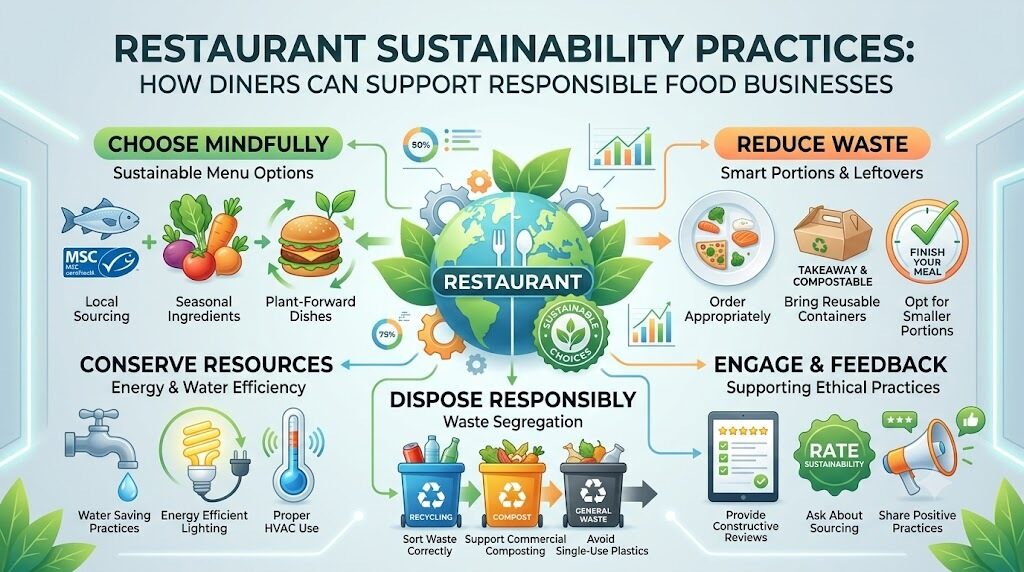
A restaurant offers more than food. It also makes daily decisions about ingredients, water, electricity, packaging, purchasing, and leftover meals. These choices can influence how efficiently a business operates and how much waste it produces. Although customers may not see every process behind the kitchen doors, they can still learn about a restaurant's approach to responsible dining.
Restaurant sustainability does not require every business to follow the same methods. One restaurant may focus on buying ingredients from nearby suppliers, while another may improve energy efficiency, reduce food waste, or use reusable service items. The most suitable approach depends on the business, its resources, and the needs of its customers.
FindMyResto helps diners discover restaurants, review available business information, explore menus, and contact restaurant owners directly. These features can support customers who want to ask questions before choosing where to eat.
Understanding practical sustainability measures can help diners make informed choices while giving restaurant owners useful ideas for communicating their efforts honestly.
What Does Restaurant Sustainability Mean?
Restaurant sustainability means managing food service in ways that consider resource use, waste, purchasing decisions, and long-term business operations. It can include environmental practices, responsible sourcing, efficient equipment, and thoughtful food preparation.
A sustainable approach does not look identical everywhere. A small café may reduce waste by adjusting its daily preparation quantities, while a larger restaurant may review refrigeration, lighting, supplier arrangements, and water use.
Some businesses may also focus on seasonal ingredients when suitable supplies are available. Others may improve how they store food, reuse eligible materials, or separate waste for appropriate collection.
It is important to distinguish practical action from marketing language. A restaurant describing itself as environmentally responsible should be able to explain the specific measures it takes. One action alone does not prove that every part of the business follows sustainable practices.
Customers can ask straightforward questions about ingredients, sourcing, waste reduction, and service materials. Restaurant owners can answer with clear examples rather than broad claims.
A thoughtful approach focuses on improvements that are realistic for the business and meaningful to its operations. It also recognises that food safety, ingredient quality, affordability, and customer needs remain important parts of running a restaurant.
Why Sustainability Matters to Diners and Restaurant Owners
Sustainability can affect how a restaurant purchases ingredients, plans its menu, manages its kitchen, and serves customers. Better planning may help a business use supplies more efficiently and understand where avoidable waste occurs.
For diners, learning about these practices can make restaurant selection more informed. Some customers may prefer businesses that explain where their ingredients come from. Others may be interested in reduced packaging, seasonal food, or efforts to manage leftovers responsibly.
Restaurant owners have to balance these interests with practical limitations. A particular ingredient may not be available from a nearby supplier throughout the year. Reusable service items may require suitable washing facilities. Changes to equipment can also involve upfront costs.
Sustainability should therefore be considered as an ongoing process rather than a promise of perfection. Small, measurable improvements can be useful when they suit the business and are maintained consistently.
An Online Restaurant Directory can help diners discover food businesses and review the information each business provides. Customers can then contact restaurants to ask about practices that matter to them.
FindMyResto.com supports restaurant discovery and direct communication. It can help users identify businesses to explore, but individual sustainability claims should be confirmed with the restaurant rather than assumed from a profile.
Finding Restaurants Near Me That Explain Their Practices
When customers want to support responsible food businesses, location can be a useful starting point. A nearby restaurant may be convenient for regular visits and may offer opportunities to learn more about its ingredients and daily operations.
Searching for Restaurants Near Me can help diners discover local businesses. They can review descriptions, available menus, photographs, and contact details before deciding where to eat.
However, proximity alone does not establish whether a restaurant follows sustainable practices. A nearby business may have detailed waste-reduction procedures, while another may focus on sourcing or efficient equipment. Customers should look for specific information rather than relying on assumptions.
Useful questions include:
Does the restaurant explain where selected ingredients come from?
Does it offer information about seasonal menu changes?
How does it manage food that remains after preparation or service?
Does it take steps to avoid unnecessary packaging?
Can staff explain any environmental claims made by the business?
FindMyResto.com helps users explore restaurants by location, cuisine, price range, and business type where those options are available. Restaurant profiles may contain useful background information, while direct contact can clarify details that are not published.
A practical choice combines a suitable location, food preferences, and trustworthy information about the business.
Restaurant Menus and Prices: Understanding Seasonal and Local Choices
Restaurant Menus and Prices can help customers understand the food a business serves and the general cost of a meal. They can also provide clues about whether the menu changes according to ingredient availability, although customers should not assume that a seasonal menu automatically means local sourcing.
Some restaurants adjust their offerings when particular ingredients are plentiful. This may help them plan purchases around available supplies, but the actual approach varies by business and location.
When reviewing Restaurant Menus and Prices, look for clear descriptions of ingredients and any information the restaurant provides about sourcing. If a menu mentions local or seasonal ingredients, ask which items qualify and whether availability changes during the year.
Price information also matters. Seasonal ingredients do not always cost less, and locally sourced food is not automatically cheaper than ingredients supplied from farther away. Production methods, transport, availability, and supplier arrangements can all affect costs.
A Restaurant Menu Website may help customers review dishes before visiting. However, published menu information may not explain the restaurant's purchasing process or waste-management practices.
FindMyResto.com can help diners explore menus where businesses provide them. Customers can use the available contact information to ask specific questions about ingredient sourcing, seasonal changes, or menu availability.
How an Online Restaurant Directory Helps Customers Explore Responsible Dining
An Online Restaurant Directory brings information about different food businesses together, making it easier to discover places that may suit a customer's preferences.
Depending on the details supplied by each restaurant, a listing may include the business description, location, photographs, opening hours, food specialties, menu information, and contact details. These details help users create a shortlist before asking more specific questions.
FindMyResto.com is a global Restaurant Discovery Platform that helps diners explore restaurants, discover menus, compare options, and contact owners directly.
For customers interested in sustainability, the discovery process can begin with restaurants in a preferred area or cuisine category. Once a shortlist is ready, users can ask businesses about ingredient sourcing, food waste, packaging, and other practices.
A directory should not be treated as an independent certification of sustainability. A profile may provide information supplied by the business, but it does not automatically verify every environmental claim.
Customers should look for clear explanations and specific examples. Restaurant owners can make this easier by describing what they actually do and avoiding claims that are broader than their practices support.
Online discovery is most useful when it leads to better questions and informed decisions, rather than assumptions based on a restaurant's appearance or promotional wording.
Find Restaurants by Cuisine and Understand Ingredient Choices
Cuisine can influence the ingredients a restaurant purchases, the way food is prepared, and how menus change with availability. However, no cuisine is automatically more sustainable than another. Practices depend on the restaurant's suppliers, menu planning, preparation methods, and operating choices.
The Find Restaurants by Cuisine approach helps customers discover businesses that serve food styles they enjoy. Once they identify suitable restaurants, they can explore the menu and ask how selected ingredients are sourced.
For example, a restaurant may explain that certain vegetables are purchased from nearby suppliers when available. Another may use different suppliers for different ingredients because of quality, volume, or seasonal availability.
Customers should avoid assuming that every ingredient in a dish comes from the same source. Restaurants may purchase ingredients from several suppliers, and sourcing can change.
FindMyResto can help users explore businesses by cuisine and location where these search options are available. Profiles may provide descriptions and menu details, while direct communication allows customers to ask more specific questions.
The goal is not to judge a restaurant based on one ingredient. Instead, customers can consider the information available, understand the business's approach, and decide whether it aligns with their own preferences.
Affordable Restaurants Near Me and Responsible Choices
Responsible dining does not have to mean choosing the most expensive restaurant. Customers can consider practical factors such as menu prices, portion options, location, and the information a business provides about its operations.
Searching for Affordable Restaurants Near Me can help users discover businesses that fit their spending limits. After reviewing available menu prices, customers can ask about ingredient choices or other practices that matter to them.
It is important not to assume that higher prices automatically indicate better sustainability. A restaurant may charge more for many reasons, including location, labour, ingredient costs, and service style. Likewise, a lower-priced restaurant may have useful waste-reduction or purchasing practices.
Restaurant Menus and Prices can help customers estimate the cost of a meal before visiting. When comparing options, consider the whole experience rather than using price as the only measure.
Food waste is another practical area to consider. Customers can order portions that suit their appetite and ask about available portion sizes when needed. Restaurants can review preparation quantities and customer demand to avoid producing more food than they can reasonably serve.
FindMyResto.com helps users explore restaurants and compare available business information. Customers can use these details to find options that fit their budget while asking businesses about specific practices.
Restaurant Food Waste: Practical Steps for Diners and Owners
Food waste can occur at several points, including purchasing, storage, preparation, cooking, and customer service. Reducing avoidable waste requires attention to the whole process rather than focusing only on uneaten food at the end of a meal.
Restaurants can review which ingredients spoil before use, identify dishes that are regularly left unfinished, and adjust preparation quantities where appropriate. Staff training and suitable storage procedures can also help food remain safe and usable for its intended purpose.
Customers have a role as well. Reviewing the menu carefully, choosing suitable portions, and communicating clearly about orders can reduce the chance of unwanted food being prepared.
Restaurants may offer takeaway containers for suitable leftovers, depending on their policies and food-safety requirements. Customers should follow the restaurant's guidance about safe storage and how soon food should be consumed.
Owners should never compromise food safety in an effort to reduce waste. Ingredients that are no longer safe must be discarded appropriately.
A Restaurant Discovery Platform can help customers find businesses, but waste-reduction practices are usually best confirmed directly with the restaurant. Asking specific questions gives owners an opportunity to explain their process without making unsupported claims.
What Is a Restaurant Discovery Platform?
A Restaurant Discovery Platform helps people find and compare restaurants using information such as location, cuisine, price range, business type, and available menu details.
FindMyResto.com helps users explore restaurant profiles and contact business owners directly. Depending on the information supplied, a profile may include photographs, descriptions, food specialties, opening hours, location, dining options, and contact methods.
For sustainability-minded customers, the platform can be a starting point for discovering businesses they want to learn more about. Users can shortlist restaurants based on their food preferences and location, then ask questions about sourcing, waste reduction, or packaging.
The platform does not automatically certify restaurants as sustainable or verify every claim about environmental performance. Customers should seek clear details from the business and avoid assuming that a particular label proves a complete set of practices.
Restaurant owners can also use online profiles to explain practical steps they have taken. Specific statements, such as describing a food-waste review or explaining how ingredients are selected, are generally more informative than vague promises.
A Restaurant Discovery Platform is most useful when it helps diners move from finding a business to understanding whether that business fits their needs.
Free Restaurant Listing for Food Businesses
A Free Restaurant Listing can help a food business present its information online and make it easier for customers to discover the establishment.
Restaurants, cafés, bakeries, bars, and food trucks may use a listing to share their name, location, description, contact details, opening hours, and available menu information, depending on the supported fields.
FindMyResto.com provides an opportunity for eligible businesses to create a listing and help diners explore their offerings.
For owners who want to communicate sustainability efforts, clear information is important. A business might explain that it adjusts preparation quantities to reduce waste, reviews supplier options, or provides reusable service items where practical. Such statements should accurately describe what the restaurant does.
Avoid broad claims such as saying the entire business has no environmental impact. Restaurant operations involve many different activities, and a single improvement does not prove that every process is sustainable.
A Free Restaurant Listing does not automatically verify environmental practices or guarantee customer growth. Its purpose is to make business information easier to discover.
Owners should keep descriptions and menus accurate, update details when practices change, and be prepared to answer questions about any claims they publish.
How to List Your Restaurant Online with Clear Information
Restaurant owners who want to List Your Restaurant Online should focus on accuracy, useful details, and clear communication.
Start with the restaurant's correct name, location, business type, opening hours, and contact information. Add a short description that explains the food offered and the dining experience. Include photographs and menu information where supported and available.
If sustainability is part of the restaurant's approach, explain specific practices instead of relying on general promotional language. For example, describe how the business manages food preparation, chooses suppliers, or reduces unnecessary materials, provided those statements are accurate.
A useful checklist includes:
Enter the correct business name and location.
Provide current opening hours and contact information.
Describe the cuisine and dining options clearly.
Add available menu details and prices where appropriate.
Use photographs that accurately represent the business.
Explain sustainability practices with specific examples.
Avoid unsupported environmental claims.
Review the listing whenever business information changes.
FindMyResto.com can help eligible food businesses present their information through a Free Restaurant Listing. Owners remain responsible for the accuracy of their claims and for ensuring that any environmental or sourcing statements reflect their actual operations.
A clear online profile can help customers understand the business before visiting, while direct communication gives them an opportunity to ask further questions.
A Restaurant Menu Website Made Simple
A Restaurant Menu Website helps customers review the food options available at a restaurant before deciding where to eat. It can also provide space for useful information about ingredients, menu changes, and available dining services when the business chooses to publish those details.
A helpful menu page may include menu categories, item descriptions, prices where provided, and information about the restaurant's food specialties. If the menu changes with ingredient availability, the restaurant can explain that where appropriate.
However, a menu alone cannot establish whether a restaurant follows sustainable practices. A dish description may identify an ingredient without explaining where it was purchased, how it was transported, or how the business manages leftover supplies.
FindMyResto.com profiles may serve as simple online information pages when restaurants provide descriptions, photographs, menus, and contact details.
Customers can use these details to understand the restaurant's offerings and then contact the business with questions about sourcing or waste management. Owners should avoid using sustainability labels unless they can explain what those labels mean in practice.
A Restaurant Menu Website works best when it provides current, useful information and makes it easy for customers to contact the restaurant for details that are not covered on the menu.
Common Mistakes to Avoid
1. Assuming every local ingredient is automatically sustainable
Local sourcing can reduce some transport needs, but the full impact also depends on production methods, storage, availability, and other factors.
2. Treating higher prices as proof of better practices
Price does not independently establish sustainability. Ask about specific actions instead of relying on cost as a signal.
3. Believing every environmental claim without asking questions
Look for clear explanations and examples. Broad promotional statements may not explain what the business actually does.
4. Assuming a seasonal menu proves local sourcing
Seasonal ingredients may come from different suppliers. Ask the restaurant where selected ingredients originate if this matters to you.
5. Ordering more food than you can reasonably eat
Consider portion size and ask about available options. This can help avoid unnecessary leftovers.
6. Ignoring food-safety requirements
Food should never be kept or reused when it is unsafe. Waste reduction must remain consistent with proper food handling.
7. Assuming an online listing is an environmental certification
An Online Restaurant Directory helps users discover businesses, but a listing alone does not verify sustainability claims.
8. Making vague sustainability promises as a restaurant owner
Describe specific practices that the business actually follows rather than making claims that cannot be supported.
9. Forgetting to update menu and sourcing information
Suppliers and ingredient availability can change. Keep published details current and explain changes when necessary.
10. Judging a restaurant on one practice alone
Sustainability involves many operational decisions. Consider the available evidence rather than expecting one action to represent the entire business.
A Simple Example
Imagine a fictional diner wants to choose a restaurant that takes food waste seriously and explains its ingredient choices.
The diner begins by searching for Restaurants Near Me and reviewing available restaurant profiles. On FindMyResto.com, they compare businesses by location, cuisine, and available menu information.
One restaurant's description mentions that it reviews food preparation quantities to help reduce waste. The diner contacts the business and asks what that process involves. The staff explains that the kitchen monitors ingredient use and adjusts preparation plans according to expected demand.
The diner also asks whether the menu changes when certain ingredients become available. The restaurant explains that some menu items may vary depending on supplies.
With this information, the diner decides whether the restaurant's approach matches their preferences. The decision is based on clear communication rather than assuming that the restaurant is perfect in every area.
This fictional example shows how online discovery and direct questions can help customers understand a business's practices. It does not imply that every restaurant listed on FindMyResto.com follows the same methods.
How FindMyResto Can Help
FindMyResto helps diners discover restaurants, explore available menu information, compare businesses, and contact owners directly.
Users can search by restaurant name, location, cuisine, price range, and business type where those options are available. Depending on the information supplied by a business, a profile may include photographs, descriptions, opening hours, food specialties, dining options, and contact details.
These features can help sustainability-minded diners create a shortlist before asking restaurants about ingredient sourcing, food waste, packaging, or other practices. The platform provides a starting point for discovery rather than a guarantee that a business follows a particular environmental standard.
Restaurant owners can use a Free Restaurant Listing to make their business information easier to find. Clear descriptions and accurate menu details can help customers understand what the restaurant offers.
Owners should describe their sustainability measures honestly and update published information when necessary. Customers, in turn, can ask focused questions to understand what those measures involve.
By connecting restaurant discovery with direct communication, FindMyResto.com can help diners explore food businesses that match their preferences and give owners an opportunity to explain their approach.
Frequently Asked Questions
1. How can I find Restaurants Near Me that focus on sustainability?
Search for restaurants in your preferred area, review their available profiles, and look for specific information about sourcing, waste reduction, or packaging. FindMyResto.com can help you discover businesses and contact owners. Ask direct questions when sustainability details are not included in the listing.
2. Can Restaurant Menus and Prices help me identify responsible food choices?
Restaurant Menus and Prices can show available dishes and help you understand the cost of a meal. Some menus also describe ingredients or seasonal offerings. However, menu details alone cannot verify sourcing or waste practices, so contact the restaurant if those details matter to your decision.
3. Does an Online Restaurant Directory certify sustainable restaurants?
An Online Restaurant Directory helps users discover businesses and review the information each restaurant provides. A listing does not automatically certify environmental performance or verify every claim. Look for specific explanations and ask the business about its practices before making assumptions based on promotional wording.
4. How can I Find Restaurants by Cuisine while considering sustainability?
Use Find Restaurants by Cuisine to identify businesses that serve the food styles you prefer. Review available menu information and ask restaurants about selected ingredients, sourcing, and seasonal availability. No cuisine is automatically more sustainable than another; the answer depends on the business's actual purchasing and operating practices.
5. Are Affordable Restaurants Near Me able to follow responsible practices?
Yes. Sustainability practices are not limited to expensive restaurants. Affordable Restaurants Near Me searches can help you discover businesses within your budget. You can then ask about food waste, purchasing, and packaging. Price alone does not prove whether a restaurant manages resources responsibly.
6. What is a Restaurant Discovery Platform used for in responsible dining?
A Restaurant Discovery Platform helps users explore restaurant profiles, compare available information, and contact businesses directly. FindMyResto.com supports this process, but it does not automatically verify sustainability claims. Customers should use the platform to discover possible options and then ask restaurants for details about their practices.
7. What should owners include in a Free Restaurant Listing?
Owners should provide accurate business details, location, opening hours, contact information, and available menu information. If they discuss sustainability, they should describe specific practices that the business genuinely follows. A Free Restaurant Listing improves discoverability but does not independently certify environmental performance or guarantee business results.
8. How can restaurant owners List Your Restaurant Online and explain sustainability?
Owners can List Your Restaurant Online by providing clear business information, menu details, and contact methods where supported. They should describe sourcing, waste reduction, or resource-saving measures accurately and avoid unsupported claims. Keeping the profile updated helps customers understand the business before contacting or visiting it.
9. Can a Restaurant Menu Website explain where ingredients come from?
A Restaurant Menu Website can include ingredient or sourcing information if the restaurant chooses to publish it. However, a menu may not explain every supplier or purchasing decision. Customers who need specific details should contact the business, particularly when ingredient origin or seasonal availability influences their choice.
10. Does FindMyResto guarantee that listed restaurants follow sustainable practices?
No. FindMyResto helps diners discover restaurants, explore available information, and contact owners directly. A listing should not be treated as environmental certification. Customers should ask businesses about the practices they care about, while restaurant owners should ensure that any published sustainability claims accurately reflect their operations.
Final Thoughts
Restaurant sustainability involves many practical choices, from ingredient purchasing and menu planning to food waste and resource use. No single action proves that a business follows every responsible practice, so clear information and realistic expectations are important.
Diners can begin by discovering restaurants, reviewing available menus, and asking focused questions about the practices that matter to them. FindMyResto can support that process by helping users explore businesses and contact owners directly.
Restaurant owners can make their efforts easier to understand by describing specific actions instead of relying on broad promises. Accurate listings and honest communication help customers make informed decisions.
Responsible dining is not about expecting every restaurant to operate in exactly the same way. It is about understanding available information, recognising practical improvements, and choosing businesses with care.