How to Evaluate News Credibility With an AI News Aggregator Before Sharing Information
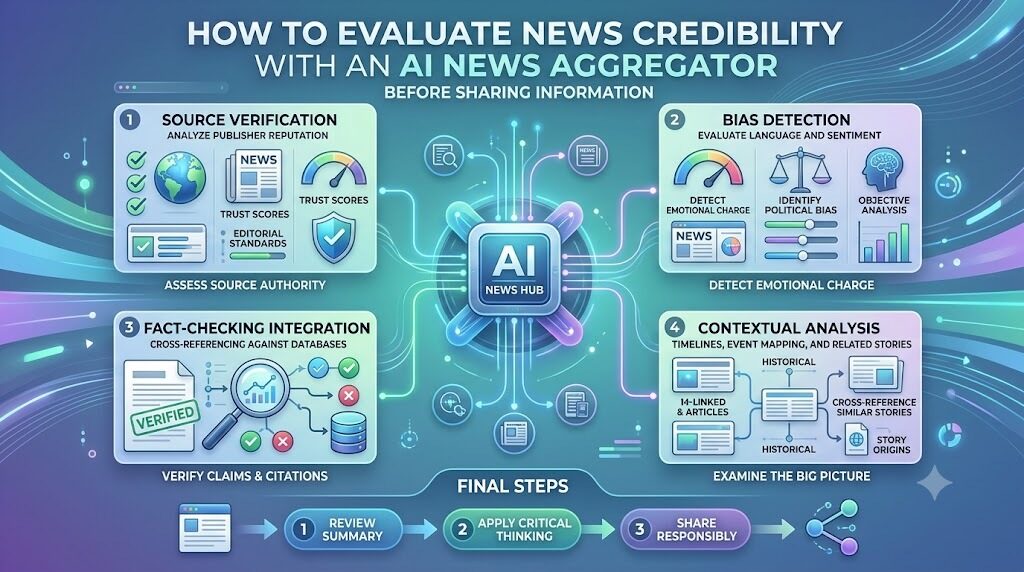
Introduction
Sharing news online takes only a few seconds. A headline can appear convincing, emotional, or important enough to forward to friends and family immediately. However, information can be incomplete, outdated, misleading, or presented without the context needed to understand it correctly.
Responsible sharing starts with a simple habit: check the information before passing it along. An AI News Aggregator can help readers discover reports from different sources, while an AI News Summarizer can make lengthy articles easier to review. Neither tool can guarantee that a claim is true, so readers must still examine the original reporting.
HeadlineSift helps readers discover headlines from hundreds of news sources across countries and categories. This can provide a starting point for checking a story before sharing it with others. By examining publication dates, source details, supporting evidence, and missing context, readers can make more informed decisions about what deserves their attention and what should remain unshared.
What Does News Credibility Mean?
News credibility refers to how much confidence readers can reasonably place in a report based on its evidence, sourcing, accuracy, and context. It does not mean accepting every statement from a familiar publication or rejecting every report from an unfamiliar one.
A credible report usually makes its central claims understandable and provides information that readers can examine. Depending on the story, that information might include documents, interviews, data, official statements, or direct observations.
Readers should also recognize that a reliable publication can make mistakes. Corrections, incomplete information, and changing circumstances can affect even carefully prepared reporting.
An AI News Aggregator can help readers locate different reports about the same subject. This is useful when checking whether a claim appears in broader coverage, but the number of matching headlines does not establish accuracy.
HeadlineSift.com can help readers discover stories worth examining. The next step is to evaluate the evidence behind each important claim rather than judging a story by its headline alone.
Why Checking News Before Sharing Matters
Incorrect information can spread quickly when people share it without checking the details. A misleading claim may influence personal decisions, damage someone's reputation, or create unnecessary fear.
The problem is not limited to completely false stories. A genuine report can become misleading when someone removes an important qualification, changes the date, or shares a small part of the article without its original context.
For example, a report about a proposed policy may be shared as though the policy has already taken effect. The underlying story may be real, but the shared version gives readers the wrong impression.
Checking information helps prevent these mistakes. Readers can confirm what happened, identify what remains uncertain, and decide whether the story is useful enough to share.
A Global News Aggregator can help locate coverage from different countries and regions when a claim concerns an international development. However, readers should compare the actual evidence rather than assuming that similar headlines mean independent confirmation.
What Is an AI News Aggregator?
An AI News Aggregator collects and organizes news content from multiple sources. Depending on the platform, it may classify stories, group related reports, and help users discover coverage about a particular subject.
For credibility checks, this can save time. Instead of relying on the first post that appears in a social media feed, readers can look for related reporting and identify original articles that explain the event.
Aggregation has important limitations. A platform may not include every relevant source, and several articles may repeat information from the same announcement. A collection of headlines is therefore not the same as independent verification.
HeadlineSift.com helps readers discover headlines from hundreds of news sources across countries and categories. Readers can use this discovery process to locate original reporting and investigate claims more carefully.
An AI News Aggregator should support the checking process, not make the final decision for the reader. Important information still needs to be verified through the original report and suitable supporting evidence.
How to Examine the Original Source
The original source is one of the most useful places to begin a credibility check. It helps readers understand who published the information, when it appeared, and what evidence supports the main claim.
Start by opening the full article rather than relying on a screenshot or a short social media caption. Check the publication name, author information when available, publication date, and any updates or corrections.
Next, look at the evidence. Does the article link to a relevant document or study? Does it identify where a quotation came from? Does it clearly distinguish an official statement from an independent finding?
Readers should also look for missing details. If an article makes a strong claim but provides no explanation of how that claim was established, further checking may be necessary.
A familiar publication name is not enough on its own. Fake pages can imitate legitimate websites, and genuine articles can be misrepresented when their text is copied elsewhere.
Before sharing, make sure the source actually published the material being circulated. This simple step can prevent readers from forwarding content that only appears to come from a trusted outlet.
Using an AI News Summarizer Without Losing Context
An AI News Summarizer can help readers understand the central points of a long article. It may highlight the reported event, the main people or organizations involved, and the evidence mentioned in the report.
This is useful when a story contains technical explanations or several sections. A summary can help readers decide which details need closer attention.
However, summaries can omit qualifications or misunderstand complicated statements. A short explanation may also make an uncertain claim sound more definite than the original article intended.
Readers should compare the summary with the source text before sharing any important conclusion. Pay particular attention to numbers, quotations, dates, and statements about responsibility or cause.
If a summary says that a report confirmed something, check whether the original article actually confirms it or merely describes an allegation, prediction, or preliminary finding.
An AI News Summarizer is best used as a reading aid. It can help readers navigate information, but it should not replace the source material when accuracy matters.
Why Curated News Headlines Need Careful Review
Curated News Headlines can make it easier to discover stories related to a particular subject. They help readers focus on potentially relevant reports rather than searching through large amounts of unrelated content.
However, a headline is a short description, not the full evidence. It may emphasize the most interesting aspect of a story while leaving out important conditions or uncertainty.
Two headlines about the same event can also use different language without actually disagreeing about the facts. Readers should examine the article content before deciding that a contradiction exists.
When reviewing curated results, ask whether each story adds original information, explains the background, or simply repeats another report. This distinction is especially important when many websites cover a widely discussed event.
HeadlineSift.com can help readers discover headlines across news categories. Readers should then open relevant reports and judge their claims using the information available in the full articles.
The purpose of curation is to make discovery easier. It does not remove the need to check relevance, context, and evidence.
Checking Urgent Claims With a Breaking News Aggregator
Urgent headlines can create pressure to react immediately. Stories involving emergencies, public safety, major announcements, or developing investigations may spread before all the facts are available.
A Breaking News Aggregator can help readers locate updates about a developing event. However, early reports may rely on preliminary information that changes as more evidence becomes available.
Check the publication time and look for later corrections or updates. A story published recently may still repeat an earlier claim rather than provide genuinely new information.
Readers should also distinguish between confirmed details and statements attributed to officials, witnesses, or other people involved. An attributed statement establishes that someone made a claim; it does not automatically prove that the claim is correct.
Avoid sharing urgent claims simply because many people are discussing them. When the evidence is incomplete, waiting for clearer information is often more responsible than forwarding an uncertain report.
A Breaking News Aggregator can support discovery during fast-moving situations, but original reporting and relevant official information should guide decisions about what to trust.
Comparing International Reports Fairly
International stories can be described differently across countries because publications may focus on different local concerns. Differences in wording do not automatically mean that one report is false.
A Global News Aggregator can help readers discover coverage from different regions. This is useful when a story involves international relations, cross-border business, public health policy, or global technology developments.
When comparing reports, identify the facts that they share and the details that differ. Then examine whether those differences come from separate evidence, different publication times, local context, or varying interpretations.
Readers should avoid assuming that a report from another country is automatically more objective. Every report needs to be evaluated on its evidence and reporting methods.
Translation can also introduce confusion. A translated quotation or headline may not capture every nuance of the original wording, so readers should be careful when interpreting subtle differences.
A Global News Aggregator can broaden the search, but fair comparison requires attention to context. Readers should explain genuine disagreements accurately rather than choosing the report that best supports their existing opinion.
Evaluating Technology Claims and Online Rumors
Technology stories often involve new products, artificial intelligence, privacy, cybersecurity, and claims about performance. Some reports describe demonstrated results, while others repeat predictions or promotional statements.
A Technology News Aggregator can help readers discover related coverage and identify reports that discuss the same claim. Readers should then examine the evidence behind the technical explanation.
Look for details about how a product was tested, who conducted the research, and whether the findings have important limitations. A company's announcement may explain what it intends to achieve, but it does not automatically establish that the product performs as described.
Online rumors require similar care. A screenshot, short clip, or copied quotation may lack the original date or surrounding context. Search for the original publication or other evidence that helps establish where the material came from.
Readers should also be cautious about claims that sound technically impressive but provide no clear method of verification.
A Technology News Aggregator can help identify relevant reports, but readers should use original research, technical documentation, and independent reporting when checking claims about how a technology actually works.
Understanding Business News Claims
Business stories can influence public opinions about companies, products, jobs, and industries. Reports may discuss expansion plans, financial results, new services, or changes in company leadership.
A Business News Aggregator can help readers find different reports about the same organization or development. However, business announcements and independent assessments serve different purposes.
A company statement can confirm what the company announced. It may not independently establish whether a product will succeed, whether a business plan is realistic, or whether a reported benefit will occur.
Readers should examine the date, the exact wording, and any supporting evidence. They should also distinguish between a planned action and a completed result.
For instance, an announcement that a company intends to open new locations does not prove that those locations have already opened. Sharing the claim without this distinction can mislead other readers.
A Business News Aggregator helps with discovery, but checking the underlying announcement and relevant independent reporting is necessary before repeating a claim as fact.
Reading Financial News Headlines Responsibly
Financial stories often contain figures, forecasts, percentages, and claims about market conditions. These details can be misunderstood when readers overlook the period being measured or the context surrounding the numbers.
Financial News Headlines may describe actual results, expectations, analyst opinions, or changes in economic indicators. These categories should not be treated as interchangeable.
Check what a figure measures and whether it refers to a daily change, a quarterly result, or a longer period. Also examine whether the article explains the factors that may have contributed to the result.
Readers should be careful with headlines that suggest a guaranteed outcome. Financial markets and economic conditions can change, and a single report rarely explains every factor affecting a decision.
If a story includes a statistic, look for its original source when available. A percentage without a clear comparison period or definition may create a misleading impression.
Financial News Headlines can support general awareness, but they should not be the sole basis for investment, trading, or tax decisions. Personal financial decisions may require guidance from a qualified professional.
What Is News Impact Analysis?
News Impact Analysis examines who may be affected by a reported development and what consequences could follow. It can help readers understand why a story matters beyond the immediate event.
A sound analysis separates confirmed facts from interpretations and predictions. It explains the connection between the event and the possible outcome rather than simply presenting a strong opinion.
For example, a proposed change in transport rules might affect commuters, transport companies, and local businesses. The actual effects would depend on the final rules, implementation, costs, and conditions in each area.
Readers should ask which groups are included in the report and which perspectives may be missing. They should also consider whether the reported effects have already occurred or remain possibilities.
News Impact Analysis should make the reasoning behind a conclusion clear. It should not turn speculation into fact or suggest that every possible consequence is certain.
When readers evaluate a story's impact, they can make more informed decisions about whether the information is important enough to share and what context should accompany it.
Creating a Personalized News Digest for Responsible Sharing
A Personalized News Digest can organize news around subjects that matter to a reader. A focused reading routine may help people review relevant information without reacting to every headline that appears online.
Readers can select a few topics, such as education, technology, business, or public policy. They can then review related reports, identify important updates, and check the evidence before sharing anything.
A responsible routine should also include information that challenges an initial impression. Following only familiar viewpoints can make an incomplete explanation appear more convincing than it is.
Readers can keep simple notes about the original source, publication date, central claim, and any unresolved questions. This makes it easier to return to a story and check whether later information changes its meaning.
Personalized News Digest is a future capability for HeadlineSift.com and should not be described as a currently available feature. Readers can use headline discovery to explore subjects and develop their own careful reading habits.
Table: News Tools at a Glance
Tool Type | What It Does | Who It Helps |
|---|---|---|
AI News Aggregator | Organizes news from multiple sources | Readers checking claims across reports |
AI News Summarizer | Highlights the main points of articles | People reviewing lengthy reports |
Curated News Headlines | Helps readers discover relevant stories | Readers narrowing their search |
Breaking News Aggregator | Helps locate updates about developing events | People checking urgent claims |
Global News Aggregator | Helps discover international coverage | Readers comparing regional reporting |
Technology News Aggregator | Collects technology-related coverage | People checking technical claims |
Business News Aggregator | Organizes company and industry reporting | Readers reviewing business announcements |
Financial News Headlines | Surfaces financial developments | People seeking general financial awareness |
News Impact Analysis | Examines possible effects of an event | Readers evaluating wider significance |
Personalized News Digest | Organizes news around selected interests | Readers building a focused reading routine |
Each tool supports a different part of news discovery and review. Responsible sharing still depends on checking the original information and understanding what the evidence establishes.
Common Mistakes People Make Before Sharing News
1. Sharing from the headline alone
A headline may omit important details. Read the full report before repeating its central claim.
2. Trusting screenshots without checking the source
Screenshots can be edited, cropped, or separated from their original context. Locate the original material whenever possible.
3. Treating repeated claims as independent confirmation
Several websites may rely on the same statement. Check whether separate reporting or evidence supports the claim.
4. Ignoring the publication date
Old information may be presented as new. Check when the event occurred and whether later updates changed the original story.
5. Confusing allegations with established facts
A report may describe a claim made by one person or organization. Do not present an allegation as a confirmed outcome without supporting evidence.
6. Trusting AI summaries without checking details
Summaries can omit qualifications or misinterpret claims. Compare important statements with the original article.
7. Assuming urgent language means a story is verified
Words designed to create fear or excitement do not establish accuracy. Examine the evidence before reacting.
8. Ignoring corrections and missing context
A later correction may change the meaning of an earlier report. Review updates before sharing information that may be outdated.
9. Treating predictions as guaranteed outcomes
Forecasts and opinions are not established facts. Make the distinction clear when discussing a story with others.
10. Sharing information because it supports a personal belief
Information that matches an existing opinion can still be wrong. Check the evidence fairly, including details that challenge your first impression.
A Simple Example: Checking a Fictional Public Announcement
Imagine a fictional local authority announces plans to change the schedule of a public service. A social media post claims that the change has already taken effect and urges everyone to forward the message.
The reader first looks for the original announcement. It explains that the change is planned for a later date, so the social media post has removed an important detail.
Next, the reader checks other relevant reports and looks for any subsequent update. The reader confirms the date and distinguishes the proposed change from the current arrangement.
An AI News Aggregator can help locate related headlines, while an AI News Summarizer can provide an initial overview of longer articles. The reader still checks the original announcement before deciding what the evidence supports.
The reader then shares the correct information with the date and relevant context, rather than forwarding the misleading version. If the available evidence remains incomplete, the reader explains that uncertainty instead of guessing.
HeadlineSift.com can provide a starting point for discovering related coverage across news categories. This fictional example shows how a short source check can prevent a real misunderstanding from spreading.
How HeadlineSift Can Help
HeadlineSift helps readers discover headlines from hundreds of news sources across countries and categories. This gives readers a starting point when they want to examine a claim, locate relevant reporting, or explore how a subject is covered in different places.
Readers can use headline discovery to identify original reports and compare coverage before sharing information. The platform can help them move beyond an isolated social media post and begin examining the wider reporting around a subject.
However, no aggregation platform can guarantee that every claim is correct or that every important perspective is included. AI-generated summaries and analysis may also contain errors, so readers should verify important details against original reporting and appropriate primary sources.
A responsible approach is to check the source, date, evidence, and context before sharing. If the claim remains uncertain, readers can wait for clearer information or explain what is not yet known.
HeadlineSift.com can support the discovery stage of this process. The final decision to share information should depend on what readers can reasonably verify, not simply on how convincing a headline appears.
Frequently Asked Questions About News Credibility
1. How can an AI News Aggregator help verify a news claim?
An AI News Aggregator helps readers discover related reports from multiple sources. This can reveal additional context and help locate original reporting. However, finding similar headlines does not prove a claim is true. Readers should examine the evidence, publication dates, and independence of the reporting before sharing information.
2. Should readers trust an AI News Summarizer completely?
No. An AI News Summarizer can make lengthy articles easier to review, but it may omit qualifications or misunderstand a claim. Readers should compare important details with the original report, especially when checking quotations, statistics, allegations, or information that could influence someone's decisions.
3. Are Curated News Headlines enough to establish credibility?
Curated News Headlines help readers discover relevant stories, but they do not establish whether a claim is accurate. A headline may omit context or repeat another report. Open the article, examine its evidence, and look for reliable supporting information before treating the claim as confirmed.
4. How should readers check a Breaking News Aggregator result?
Check the publication time, original reporting, and any later updates. Early reports may contain incomplete details, and some claims may change as more evidence becomes available. When information remains uncertain, avoid sharing it as a confirmed fact or wait for clearer reporting.
5. Why compare reports through a Global News Aggregator?
A Global News Aggregator helps readers discover coverage from different countries and regions. Comparing reports can reveal missing context or different interpretations. However, readers should evaluate the evidence in each article rather than assuming that geographic variety automatically makes the coverage accurate or balanced.
6. How can a Technology News Aggregator help check technical claims?
A Technology News Aggregator can help readers find related reports about products, research, and digital developments. Readers should then examine testing methods, technical documentation, and independent evidence when available. Promotional claims and predictions should not be treated as proven results without supporting information.
7. What should readers check in a Business News Aggregator report?
Readers should identify the original source, publication date, and exact claim. Company announcements can establish what an organization has stated, but they do not automatically prove that a planned action succeeded. Independent reporting and supporting evidence can help provide a fuller understanding.
8. How should readers handle Financial News Headlines before sharing them?
Check the figures, comparison periods, original data, and whether the article describes a result or a forecast. Avoid presenting uncertain predictions as guarantees. Financial news is useful for general awareness, but personal investment, trading, and tax decisions may require advice from a qualified professional.
9. What role does News Impact Analysis play in credibility checks?
News Impact Analysis helps readers examine who may be affected by an event and what consequences are supported by the available evidence. It should distinguish confirmed outcomes from predictions and explain its reasoning. This helps prevent opinions or possible effects from being shared as established facts.
10. Does HeadlineSift.com provide a Personalized News Digest?
HeadlineSift.com helps readers discover headlines from hundreds of sources across countries and categories. Personalized News Digest is a future capability, so readers should not assume it is currently available. Readers can use headline discovery to explore subjects and then verify information before sharing it.
Final Thoughts
Responsible news sharing begins with a willingness to check information before passing it along. Headlines can introduce important subjects, but source details, publication dates, original reporting, and supporting evidence help readers understand what a story actually establishes.
An AI News Aggregator can make it easier to discover related coverage, while summaries can help readers navigate longer articles. Neither tool removes the need for independent checking, especially when a claim is urgent, controversial, or financially important.
HeadlineSift provides a starting point for discovering headlines across countries and categories. By checking the original report and being honest about uncertainty, readers can share information more carefully and reduce the spread of avoidable misunderstandings.